

Previously in Internet Book Club:
Like, Follow, Subscribe by Fortesa Latifi is a book about momfluencers, family vloggers, and the impact that putting one’s life online has on parents and children. It is not the first work of its kind - see Momfluenced, or reporting on child influencers from the New York Times - but it’s one of the most thoroughly reported books on the topic that I’ve seen. The book doesn’t have a particularly insightful philosophical angle, or a persuasively argued grand theory to push. What it does have is a surprisingly large number of frank, on-the-record conversations with influencer parents and kids, and those conversations are incredibly illuminating. If you want to better understand the business and culture of family influencers, Like, Follow, Subscribe is a good place to start.1
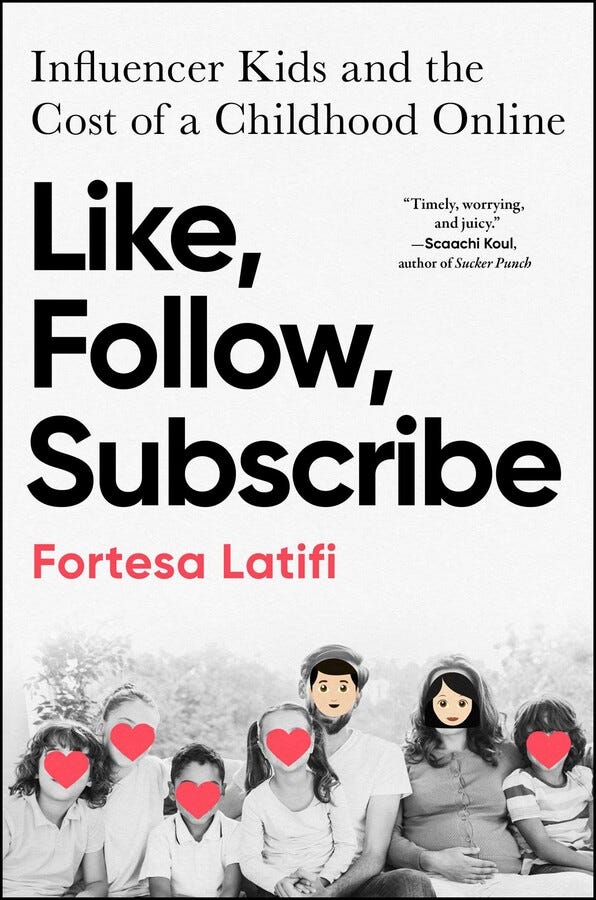
The book has a number of strengths. There’s a very interesting section on snark communities and the particular oddities of parasocial relationships (more on this to come in a future post). There are chapters about the history of mommy bloggers, the Mormon influence on parental influencers, the economics of making money on TikTok and YouTube, dealing with online predators, and legislation concerning kids who perform on social media. But the book’s core strength is in its candid conversations with internet-famous families.
Reading Latifi’s conversations with parental influencers, you can practically taste the cognitive dissonance. Almost every single parent in the book who puts their children all over social media realizes, on some level, how fucked up what they’re doing is. They understand the problematic nature of being a child influencer and the negative effects it has on their children’s development, on their relationship with their children, and more. But they bounce back and forth between acknowledging those problems and then excusing what they do anyway.
The justifications given are myriad. Some are relatively high-minded - we’re helping other families! We’re ‘shining a light’2 for the world! We’re showing people the real side of parenting! What we do is inspirational, or it’s promoting the idea of strong families, or it’s one of a dozen other supposedly altruistic motives.
Sometimes, the parents are more honest. Several parents with giant social media followings express ambivalence or reservations about putting their kids front and center for the world to see, but admit that it’s how they pay the bills so they aren’t going to stop. There’s a lot of “How else am I supposed to make money this good? I don’t have any other skills and I didn’t go to college. This is what pays my mortgage and puts food on the table.” And to be fair, the money some of these momfluencers make can be staggering. Several larger accounts are earning millions per year, and brand deals for even mid-level influencers can be equivalent to what they used to earn in a year.
On the more delusional end of the spectrum, many parents insist that their kids really just love being in videos every day. It’s certainly the case that some kids are born entertainers - the future theater majors of America, you might say - but the book is also littered with deeply uncomfortable stories of children who clearly do not want to be filmed but are forced to do so by parents on a deadline. One parent resorts to bribing their reluctant children with $100 bills, and when their miserable kids reject that offer, escalating to $500 and even $1,000. Another recalls panicking because they were on deadline for a brand deal, and their kids refused to cooperate. They’re very open about how they cajole, pressure, and at times outright bully their children into participating in the family’s content machine.
Why do they do it? Because it’s universally recognized that family content that includes kids does bigger numbers than content without kids. Featuring your children (as opposed to purely mom-centric or dad-centric videos) leads to more likes, more comments, more engaged fans, bigger follower counts and more virality. This is not a secret - multiple families talk about how they feel pressured by their own fans to show their kids, or how they’ve been explicitly instructed by brands to include the children in their branded product videos or the deal is off.
What’s even more disturbing are the conversations Latifi has with these momfluencers about the types of content they film. It seems to be a poorly-kept secret that the worse a child is feeling, the more engagement a post will get. “My child got hurt!” is by far the most reliable way to go viral. Multiple parents admitted to sticking a camera in the face of their sobbing, sick, or injured child to adequately capture the scene for social media, rather than just being a parent in that moment. Following close behind sickness and injury is embarrassment - making a video about your kid wetting the bed, throwing a tantrum, getting their period, or revealing a private moment is another surefire way to get big numbers.
These parents spend nearly the entire book justifying what they do, but half the time it feels like they’re trying to convince themselves and not us. It’s not clear how many of them really believe their own justifications. For many parents, the tension between the lucrative business of family vlogging and the harms it might be doing to their kids is palpable. Almost every single parent takes time to criticize those other family accounts who are abusive, driven by ego, etc - and every single one seems to think they’re an exception, ‘one of the good ones’.
The book isn’t perfect. The section on Mormonism is a little dry. It’s not bad, but it’s a reheated microwave dinner of a chapter, whose facts and arguments I’ve seen several times before. The few moments where the book delves into politics range from surface-level bland to embarrassing. There’s a chapter on legislation that feels tacked on and just isn’t very deep, and there are a few portions of the book where Latifi half-heartedly advances a “neoliberal capitalism and our economic decline is forcing desperate moms to take up social media” argument that is laughably thin and supported by literally incorrect facts. But despite a few weak points, I enjoyed the book because it offers such a rich, layered look into the lives and thoughts of family influencers.
In the very early days when I was still figuring out what Infinite Scroll was, one of the best things I wrote was a piece called There Are No Ethical Momfluencers. It makes the case you’d expect from the title, and there are a lot of parallels running between that piece, reporting Latifi has done in other publications, and the new book she’s released this year.
Not to flatter myself too much, but one of the reasons I enjoyed Latifi’s book is that she and I seem to have independently reached a number of the same conclusions about the nature of momfluencers and family vlogging. In that essay, I made several arguments about why even the ‘good’ momfluencers were navigating a moral minefield:
Children can’t meaningfully consent to being in capital-C Content (which is different from just being in family videos or photos for Facebook).
Lack of protections on hours worked, working conditions, etc, that child actors have had for decades.
The blurring of a child’s personal life and their performing life - child actors learn that the set is a set and home is home, but momfluencer kids have no time they can really be ‘off’.
The child being used for content doesn’t have any rights to the content.
The blurring of the line between parent and boss, and the guilt that comes with knowing your family relies on your public performance to pay the bills.
Latifi hits on basically every single one of these points, and in far more depth than I possibly could because she spends so much time documenting and interviewing specific families. She followed up on a lot of this in an interview with Anne Helen Petersen:
I remember the first story I wrote about influencer kids, where I talked to a young woman I called Claire who grew up in a vlogging family. At one point, she went to her Dad and said “I don’t want to do YouTube anymore.” And he was like, okay fine, but we’re going to have to move out of our new house and Mom and I are going to have to go back to work and there won’t be any money left over for “nice things.” And so she ‘decided’ to keep doing YouTube. But, in that context, is that really a decision?
Latifi also extends this analysis into a discussion of how different early mommy bloggers were from modern TikTok momfluencers. What’s interesting about the early mommy bloggers is how focused they were on motherhood itself. While most of them would post photos of their kids, the meat of the content was about the moms and not the kids. The way they talked about motherhood was revelatory - the gross parts, the tiring parts, the good and the bad rolled together. Post-partum depression, the pain of stitches popping out, and conflicted feelings about motherhood weren’t things women really discussed before mommy blogs. But where vulnerable and deeply personal written essays used to be the norm, modern momfluencers are shortform video focused and the large majority of successful accounts strive to show perfect, glowing, happy families at all times. They show their children far more than the early bloggers did, and in far more performative roles. You can see the same trend in content about teen moms - the show Teen Mom was at times quite dark, and showed its stars weeping and breaking down under pressure. Modern teen mom vloggers, by contrast, are perky, beautiful and impeccably curated, performing a highly aesthetic (and brand-safe) version of teen motherhood.
I want to close here by noting that while it’s easy (and correct) to blame the parents in influencer families for all of this, an honest examination of this ecosystem needs to place some blame on the audience as well. The parents we’re talking about are supplying something that the public clearly demands, and both sides of that equation are ethically fraught. If you follow family influencers, consider whether or not that’s a good thing to do. Hell, I spend time wondering about my own role in this. We’re now 1600 words into a newsletter about family influencers that I’ve written and that you’re reading. Are you and I part of the problem as well? I’m less sure of the answer than I’d like to be.
Attention is the currency of social media, and family influencers are competing for attention just like the rest of us. But that attention isn’t a magical force conjured out of the aether. It comes from somewhere, from us. Maybe the uncomfortable reality is that unethical family content only works because millions of ordinary people are happy to treat a child’s life as content. It’s easy to condemn the parents for turning childhood into a product. It’s harder to ask why the rest of us keep buying.
Not to be confused with Like, Comment, Subscribe, an excellent book about the rise of YouTube
A favorite phrase of Mormon and evangelical Christian momfluencers
“neoliberal capitalism and our economic decline is forcing desperate moms to take up social media”
I hate this argument. Unemployment is 4.3%. There are tens of millions of working class people who get obliterated by the statement, “what else am I supposed to do.”
There’s a lot wrong with our economy but if you’re waiting on sub 4.3% unemployment for your morals to show up, you might just be an amoral person.
I got to the part about filming kids' embarrassing moments and had to stop reading this article. I'll probably go back and finish, but the idea of filming your kid having wet the bed in order to monetize it is ... ghoulish? disgusting? immoral? I'm not even sure. And then the viewers? They find this entertaining?
I worry a lot about whether I'm a good parent, but I guess I can at least console myself that I'm better than these people.