

Previously in Internet Book Club:
I first read Patricia Lockwood’s No One Is Talking About This1 a few years ago. Unlike all of the books I’ve covered in this series before, No One Is Talking About This is a work of fiction. The nameless main character is a famous poster on what she calls ‘The Portal’, a social media network that seems to be inspired by the classic Twitter of the mid-2010s, who is catapulted to international fame after posting “can a dog be twins?”. Lockwood herself was a well known poster during that time and reportedly got the idea to write about this type of character after her famous Miette tweet went viral:2
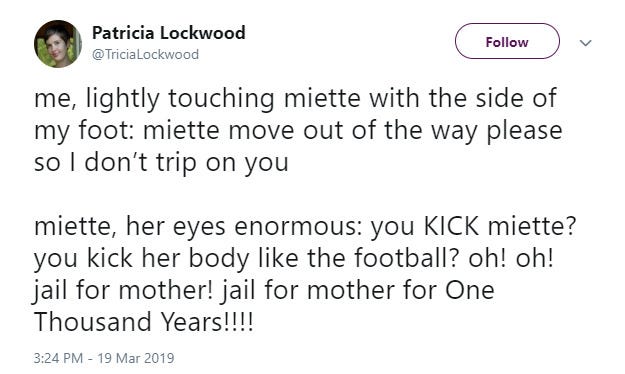
The book is loosely based on experiences from Lockwood’s own life, and it’s a remarkably unique experience to read. I want to talk about why I love this book, what makes it unique, and an underrated political reason why certain pieces of art seem to resonate so strongly.
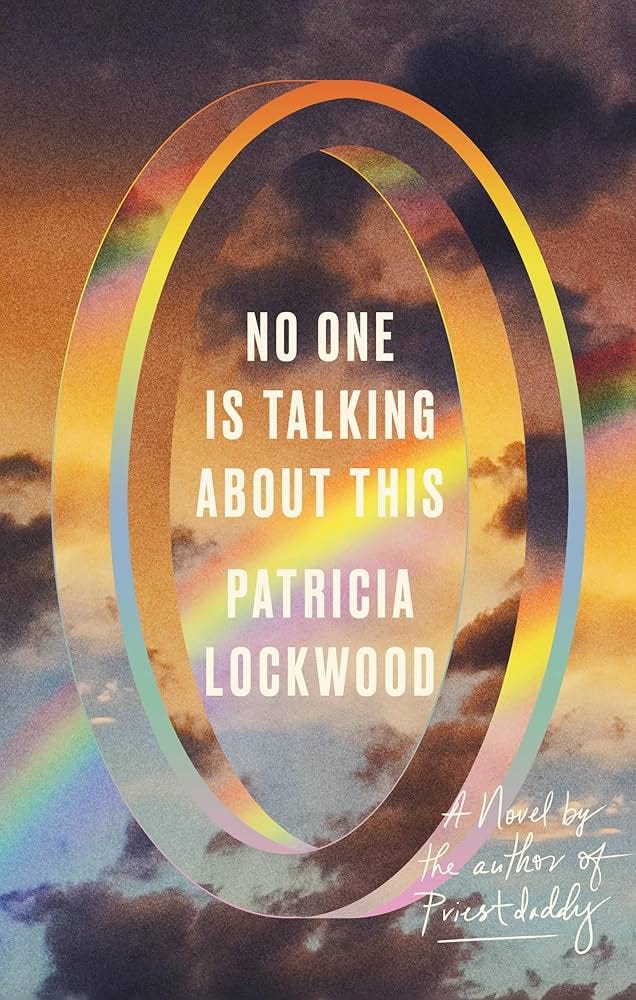
The first thing you will immediately clock about No One Is Talking About This is the book’s style. It’s written in machine gun bursts, with short sentences coming at you in rapid succession. It’s fragmented and chaotic. There are fast cuts to random new thoughts every paragraph or two, recreating the feel of reading a Twitter feed. There have been a lot of books over the years that have tried and failed to recreate the feeling of being online. This is the only book I’ve ever read that gets it right. Lockwood’s novel feels like scrolling through your For You feed in a way that no other book ever has.
With a less skilled writer, the result might be jarring, disorganized, or messy. But Lockwood makes the format work. You feel a sense of the narrative progressing, despite how scattered the main character’s thoughts are. It helps that the book is very, very funny.
It’s often hard to recommend humor to other people. Especially internet humor. Especially especially internet humor from a different era of internet. I’m aware that I’m a millennial, with a millennial’s sense of humor, and that online humor styles age badly. And yet I tell you anyway: this book is very, very funny. It will make you laugh.
The book progresses through events from the protagonist’s real life, thoughts from her time scrolling, conversations with her husband, posts she sees, posts she writes, and dream-like musings. She’s well-known enough to be invited to prestigious conferences on the What The Internet Means For Society, but spends most of her time just staring at her phone. While it’s funny, there’s often edge and insight to the main character’s thoughts:
It was a mistake to believe that other people were not living as deeply as you were. Besides, you were not even living that deeply.
-
The people who lived in the portal were often compared to those legendary experiment rats who kept hitting a button over and over to get a pellet. But at least the rats were getting a pellet, or the hope of a pellet, or the memory of a pellet. When we hit the button, all we were getting was to be more of a rat.
-
All writing about the portal so far had a strong whiff of old white intellectuals being weird about the blues, with possible boner involvement.
Our protagonist frequently confronts the idea that social media, which she dearly loves, might not actually be all that good for her, or anyone else for that matter:
Every day we were seeing new evidence that suggested it was the portal that had allowed the dictator to rise to power. This was humiliating. It would be like discovering that the Vietnam War was secretly caused by ham radios, or that Napoleon was operating exclusively on the advice of a parrot named Brian.
-
A person might join a site to look at pictures of her nephew and five years later believe in a flat earth.
As our hero asks these questions about what it means to be a person who lives their life online, she also ruminates on the politics of the day. The main character, much like Lockwood herself, is intensely progressive. But Lockwood writes the protagonist with a kind of self-awareness that perhaps the progressive politics required by social media aren’t actually all that consistent, and that perhaps the messengers of said politics aren’t all that principled. The book doesn’t really strike you over the head with it. It’s not on every page. But amongst all the references, the quips, the stories, and the meandering stream of consciousness, about every dozen pages you’ll get a fastball like one of these:
Capitalism! It was important to hate it, even though it was how you got money. Slowly, slowly, she found herself moving toward a position so philosophical even Jesus couldn’t have held it: that she must hate capitalism while at the same time loving film montages set in department stores.
-
Inside the portal, a man who three years ago only ever posted things like “I’m a retard with butt aids” was now exhorting people to open their eyes to the power of socialism, which suddenly did seem the only way.-
We wanted every last one of those bastards in jail! But more than that, we wanted the carceral state to be abolished, and replaced with one of those islands where a witch turned men to pigs.
The book is sly enough to never marinate on these moments - it’s always immediately on the next thing, just like the For You feed it’s emulating. But it’s clear that Lockwood is both deeply enmeshed in progressive circles while being skeptical of their worst qualities.
This sly political commentary is an significant feature of the book, because it points at an important idea. It’s an idea that I don’t know if Lockwood even intended, but being Death of the Author-pilled I’m fine assigning it to her regardless. What makes the book deeper and better than just being a collection of funny musings is the idea that some of the best art comes from progressive authors forcing progressive characters to confront conservative ideals.
If you haven’t read the book but plan on reading it, now might be a good time to stop (you can buy it here). Or continue! But there will be major spoilers in the next section, so you’ve been warned.
HERE BE SPOILERS
A little more than halfway through the book, the narrative of No One Is Talking About This takes a hard left turn. Up to this point, the book has been the protagonist doing a lot of humorous navel gazing, talking about posts, preening and theorizing, being goofy with her husband, debating whether “chuck e cheese can munch on my u-know-what” is clever enough to post, etc. It’s a roller coaster that as I’ve mentioned, feels like being on the infinite scroll, surrounded by one ridiculous thing after the next.
And then, out of nowhere, the protagonist gets a text from her mother.
Something has gone wrong
How soon can you get here?
The book completely, utterly changes in that moment. The protagonist is ripped out of her online world into a much scarier place, where her sister’s baby is in danger of dying before it’s even born.
Her sister’s child is diagnosed with a rare, fatal condition while in utero. The baby has no chance at a normal life - doctors expect her to die almost immediately after being born. Our main character almost violently wrenches herself out of the online world and goes to be by her sister’s side while she carries the baby, and when her niece unexpectedly survives and gets to go home from the hospital, she remains with her sister for the next six months until the baby ultimately passes away.
This section of the book is gut-wrenching. Unless you have a heart of stone, you’ll find yourself tearing up at several points. And what makes it so effective is that the character is dealing with moral values that are outside her normal experience.
The protagonist is presented as urbane, educated, left-leaning. But when her sister gets the news of her baby’s condition, abortion is never in question. The protagonist’s extended family is pro-life, and more than anything her sister just wants to spend any time she can with her baby. It’s a miracle that the baby lives past a week, that the baby gets to go home, and that they ultimately get to spend six months together. And the protagonist, while living out those six months helping mother and child, has to grapple with profoundly conservative moral ideas:
What is the value of a child’s life, even when that child has no chance to live?
Are grounded, hometown connections inherently more real than online spaces?
Is loyalty to one’s family more meaningful than fame or virality?
Can you derive meaning from righteous suffering? From carrying a burden for someone else?
These questions are small-c conservative in nature. It would be all too easy, like so many books these days, to have a left-leaning author writing a left-leaning character who deals with a left-coded issue - racism, homophobia, class discrimination, capitalism, etc. It’s more challenging and more rewarding to have that same character deal with conservative-coded issues like honor, family, loyalty, or the innocent virtue of children.
The book’s protagonist is pro-choice, and remains that way. But through her niece, she discovers for the first time the idea that something can be truly sacred. She’s spent so much time online chasing the high of posting, but that high is ultimately ephemeral and meaningless:
“A minute means something to her, more than it means to us. We don’t know how long she has—I can give them to her, I can give her my minutes.” Then, almost angrily, “What was I doing with them before?”
Jonathan Haidt’s moral foundations theory tells us that sacredness (or what Haidt would call sanctity or purity) is not a moral dimension that liberals normally care about, so the second half of this book is like watching a character whose morality is set on a two dimensional plane suddenly discover an entirely new axis on which they must measure their actions. She discovers that she loves her doomed niece with a frightening intensity. Her niece’s value is not discussed or debated, it’s intrinsic and obvious. She has to deal with grief and love and family and sacrifice, in a way that is real, raw, and completely foreign to her previous experience as an internet-famous influencer. She accepts the duty and burden of caring for her family rather than living her own life, because how could she possibly not?
In 2024 I wrote a review of the play JOB touching on this same idea:
Everyone knows that liberals and progressives dominate our cultural industries. It’s uncommon to see authentic conservative worldviews represented in elite arts culture. This is true of music, film, books, television and more, but I would argue it’s especially true of live theater. It is hard to overstate how absurdly left-leaning the Broadway community is. Being a vaguely centrist liberal who still likes Hillary Clinton might put you in the top 1% most right-leaning workers in that industry. So while I’m not a conservative myself, it’s a genuinely new and enthralling experience to watch facially progressive characters grapple with questions of conservative philosophy. Is the world fundamentally evil? Should we rehabilitate that evil, should we work through bureaucratic systems, or is it right to take matters into our own hands for the most heinous crimes? Is standing as a shield between the depraved and the innocent a morally righteous calling - even if it means sacrificing your own sanity?
In that play, a progressive character grapples with ideas about vigilantism, protecting children, and whether or not evil can be redeemed (she’s leaning towards no). And just like in Lockwood’s No One Is Talking About This, it makes for a much richer artistic thesis and for a more fully realized character journey.
The main character in this book, for all her cleverness and wit, cannot fix what has gone wrong. She cannot joke or theorize or post her way out of her sister’s grim reality. She finds meaning not in solving the problem, but in being there for her sister and niece in the brief time they have together, and in insisting that even a painful, doomed life can have significance and dignity. What makes the novel interesting isn’t that it makes this an explicit political message. It doesn’t. But it does show what sort of things melt away when we’re faced with real loss - and what remains through the hardship. And that makes for great art.
If you buy the book through this affiliate link, I earn a commission. So if you like me and plan to buy the book anyways, do it there!
The tweet spread so far it inspired an entire subreddit of cats talking in Miette voice
I also read this, perhaps on a previous recommendation you shared. I didn't enjoy it that much. The second half of the book with the dying child could've been a point where the protagonist became more aware of the difference between Internet memes and real life but the writing didn't make it seem like the protagonist learned anything. But perhaps we read it with different expectations.
Well said Jeremiah