

Previously in Internet Book Club:
Noelle Cook’s The Conspiracists: Women, Extremism, and the Lure of Belonging is remarkably straightforward in its premise. Cook warns you up front that she won’t be reviewing the entire academic literature on conspiracy theories. She won’t be doing a deep dive into each branch of the various conspiracy communities, she won’t explain every belief system in depth, and she won’t be able to provide neat solutions for how to counter conspiracism.
Instead, she aims for something much smaller. The Conspiracists is a book about two particular women who fell down the rabbit hole of conspiracism. Rather than taking a ten-thousand foot view, Cook zooms all the way in for an intensely personal look at how these women joined conspiracy communities, how their new beliefs have shaped their lives, and what we can learn from them. It’s a micro-ethnography of sorts whose primary goal is to understand just those two women. Along the way, Cook explores how women in particular are drawn into conspiratorial thinking.
The result is a book that is at various points fascinating, infuriating, and heartbreaking. I’m always glad when a book is specific in its aims rather than trying to be all things on all topics, and Cook easily passes that test. The Conspiracists is a relatively short, focused book and is well worth your time to read. But because it’s so focused, it does leave plenty of room for additional commentary and connections. In particular, I want to talk about what the book doesn’t focus on, and how that explains much of what you see online and in our politics today.
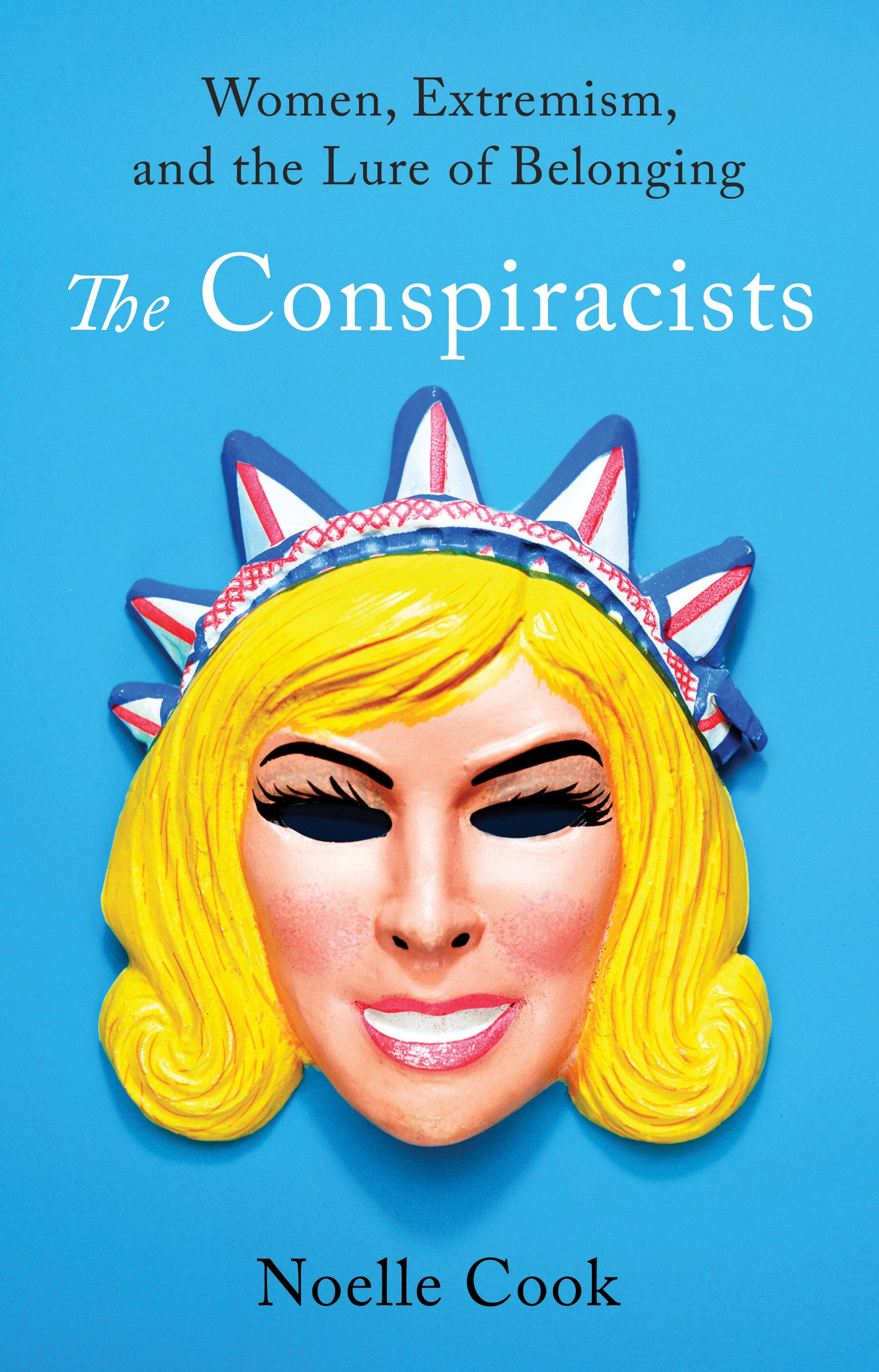
The two subjects of The Conspiracists, Tammy and Yvonne, were both a part of the January 6th riot and were both convicted for crimes they committed that day.
Cook traces the arc of their journeys to Jan. 6th through what she calls ‘conspirituality’ - the unusual blend of New Age beliefs, crunchy wellness culture, and right wing conspiracism. Tammy and Yvonne are both middle-aged white women in their 50s, and both fell hard into New Age spirituality culture before making the transition from New Age woo to QAnon and outright conspiracy. Both believe in soul contracts, starseeds, and an idea alternately called ‘Ascension’ or ‘Disclosure’ - a pseudo-apocalyptic event where spiritually prepared humans will experience total enlightenment and ‘ascend into 5D’. They don’t just sort of, kind of believe these things. They jump into them head first. They stop paying bills because Ascension is imminent. They lose friends and families and whole communities because they can’t stop raving about conspiracy theories. They proudly call themselves conspiracy theorists.
The book functions as an interesting explanation of how these two women, and women in general, fall into beliefs like these. The New Age community is overwhelmingly female and overwhelmingly white. It’s also older than you might expect, filled with Gen X and Boomers. For many, there’s a deep loneliness at the heart of New Age woo. The beliefs are attractive because these women are looking for anything at all to connect with, and New Age fills a hole, a need for belonging. In many cases, it also ends up deepening that loneliness by isolating them from their previous communities. Cook speculates that conservative/religious women in particular are vulnerable to this dynamic, because of how unimportant middle-aged women are in conservative circles. The modern right wing celebrates Trad Wives, but it’s always a young, beautiful, idealized form of femininity. Nobody’s ever celebrating or posting about the life of the Trad Wife once she’s turned fifty. And given how women are shut out of leadership positions in the most conservative and evangelical churches, it leaves middle-aged and older women with a dearth of meaning.
The book is filled with observations like this, and while it doesn’t try to advance a full theory of conspiracism, it’s insightful. At various points it uses Tammy and Yvonne’s lives to talk about ideas like:
How conspirituality can paradoxically can make conservative women more heterodox when compared to traditional evangelicals or conservatives, and even give them a few progressive-sounding ideas.
Similarly, how putting conservative/conspiratorial women into New Age woo communities makes the women more heterodox - but the large influx of conservatives also makes New Age itself more conservative over time.
How messy their belief systems are. New Age, QAnon, and similar communities operate on a sort of a la carte model of belief, where there is no central doctrine and you’re welcome to pick and choose whatever you’d like to believe.
How many people in conspiratorial communities are dealing with unresolved childhood abuse, addiction, PTSD, and other massive forms of trauma, and how conspiracies often function as a coping mechanism and a form of hope for the future.
How COVID was the first ‘awakening’ for a gigantic number of current-day conspiracists.
The Conspiracists doesn’t cover everything about the subject, but it succeeds at drawing an evocative portrait of its two protagonists, who are fascinating and troubled and worth examination. It’s an arresting read, a well written book whose pages flew by for me. If you’re interested in the subject you should absolutely buy it.
As I said above, I deeply appreciate a book that can define its scope and stick to it. So when I say that there’s a lot of ground The Conspiracists doesn’t cover, it’s not a criticism. But it does mean that there’s a lot of space for additional commentary and analysis - and there’s one particular idea that the author dances around without fully addressing. And it’s a topic that deserves a fuller examination.
