

On Adversaries, Entrepreneurs, and Algorithms
A hot take coming from someone who spends a great deal of time each day consuming brain-rot content and tracking outright poisonous social media trends: Longform reading still matters quite a lot.
Despite (or perhaps, because of) the beat I’ve chosen for myself, I still try to do a great deal of reading. I read fiction, and I read non-fiction. I read academic research and longform magazine articles. If, as the Atlantic believes, The End of Reading Is Here, I will be one of the last remaining holdouts.
There are benefits to frequently reading challenging things, especially from a diverse set of viewpoints that you might not otherwise see. And rather than give you a high-minded, abstract lecture about the Timeless Value of Reading A Book, I think it’s better to illustrate with an example. This week I found myself reading a piece of cultural criticism titled The Adversary Culture of Intellectuals by Irving Kristol. Kristol is widely known as the godfather of neoconservatism1 and he’s not the sort of writer I normally read. But I stumbled across this essay from 1979, and it has a surprising relevance to modern social media discourse.
Kristol argues that in ye olden times intellectuals saw themselves as advocating for and improving the culture they existed in, but modern intellectuals exist in an ‘adversary culture’ where they are primarily defined by criticism of their own culture. This new breed of intellectualism is distinct in its opposition to the very culture that created it - it’s against bourgeois society, against capitalism, against religion, against the traditional family, against conventional standards and tastes, against authority. It is actively hostile to its own civilization.
What do they value? Novelty, rather than tradition. Criticism over agreement. Being authentic, unique, and iconoclastic. They are bored of the things that ordinary people find respectable or valuable, and define themselves in sophisticated opposition to bourgeois, middle-class tastes. And this rebellious stance, over time, crystallizes into an entire identity.
Reading Kristol, I couldn’t help but draw analogies to the ways in which social media discourse operates today.
All of the same cultural mechanisms and incentives still exist - we’re all trying to signal sophistication, we’re trying to show that we’re interesting and unique thinkers and not just following the herd. But online, this effect is amplified even further by algorithmic systems that incentivize conflict. Agreement doesn’t drive engagement in the same way that starting a fight does. And this leads to a feedback loop where people who start fights and who are disagreeable by nature get far more attention for their cheap dunks than anyone else. Combine that with direct monetary incentives to get the most attention, and you end up with an online culture defined by the most bombastic, extreme and angry voices. Martin Gurri’s Revolt of the Public anticipated that our new media system would essentially make everyone mad about everything, all the time, forever - and he was right.
Kristol called this ‘adversary culture’, but I’d argue that social media has turned it into a new form of entrepreneurial adversary culture. We have an entire class of people today whose profession is to be maximally adversarial on all topics - and to publicly perform that conflict for money. It’s oppositional-defiant disorder but deliberately produced at an industrial scale. And it’s easy to translate this into how we talk about politics online, but the same concepts apply to sports culture, stan culture, film criticism, snark communities, and more.
Anyways! This is the sort of thing you can’t really do without deep reading, without sampling a wide variety of ideas across the political spectrum, across different generations of thinkers. Reading is not just a mechanism for downloading information, it’s also a process that allows you time to process that information. You make connections, you notice themes, and you can come up with more interesting ideas because you’re spending time contemplating the ideas without distraction. And I don’t think you can get this kind of value just from asking an AI for a bullet pointed summary.
Which Social Media has the most AI?
Speaking of AI in your social media feed - the AI detection tool Pangram recently released a report on which platforms have the most longform content that’s secretly generated by AI:
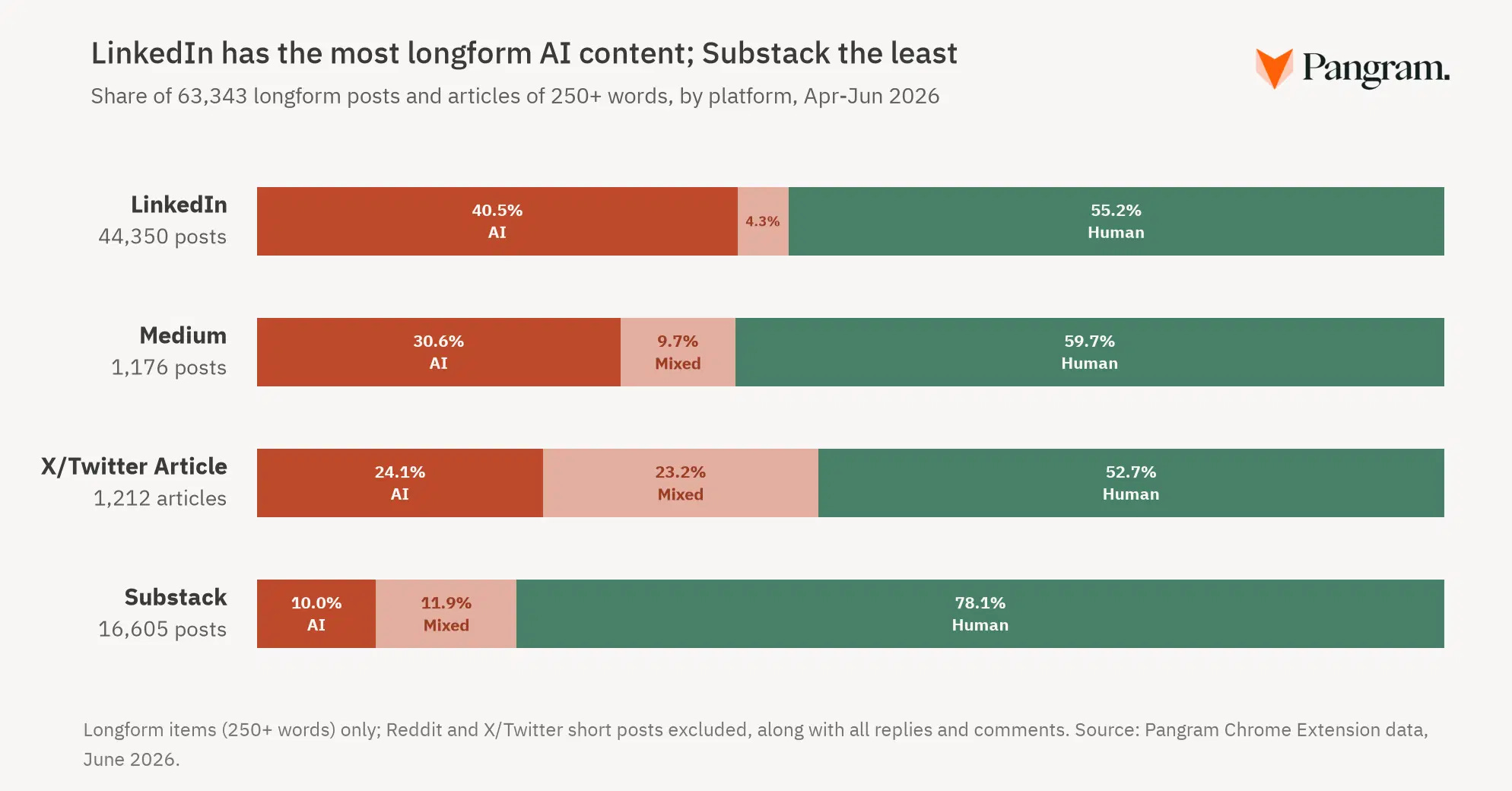
I’m not surprised at all to see that Substack has a significantly lower percentage than any other major site - although it’s a little depressing that even here, around 10-20% of posts might be AI-generated.
They also looked at replies/comments for a few platforms, and found that LinkedIn continues to be the worst:
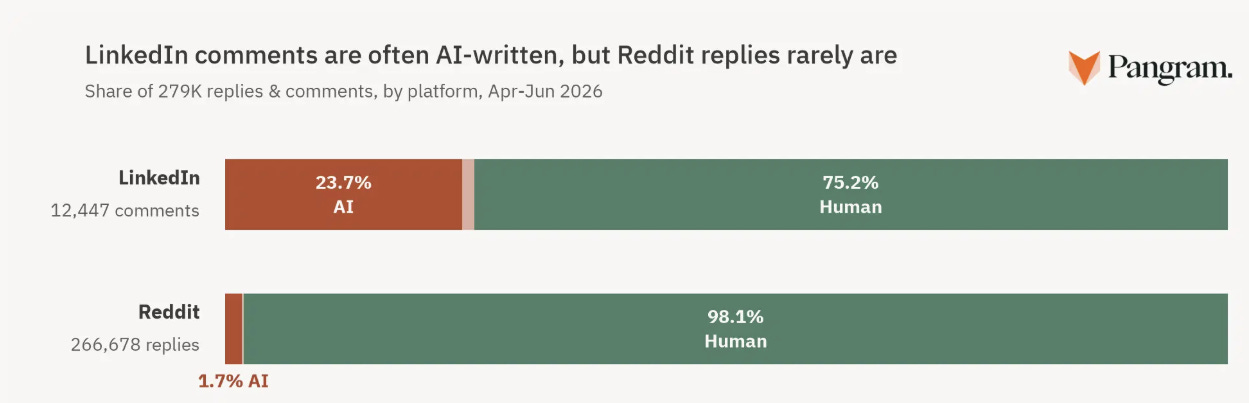
Longtime readers will remember that we talked about How To Build A Comment Section years ago, and came to the conclusion that Reddit comments are the gold standard of the internet, with a better quality-to-toxicity ratio than any other social media platform. It’s no surprise to see that they’re still mostly human and not AI - and this is why AI chatbots use them as primary sources more than any other site on the internet.
Let’s Check In With The Conservative Movement
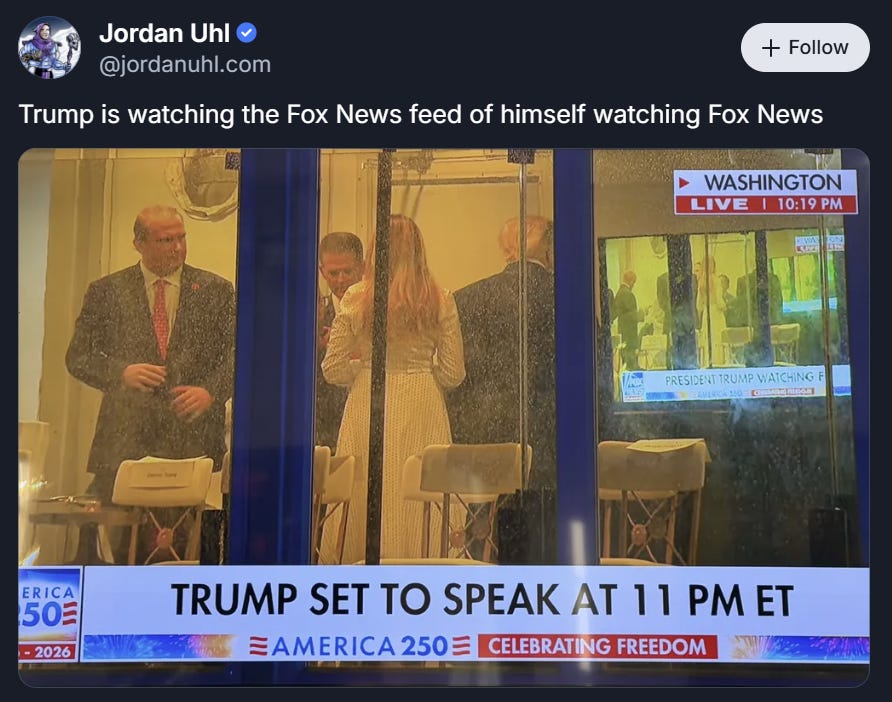
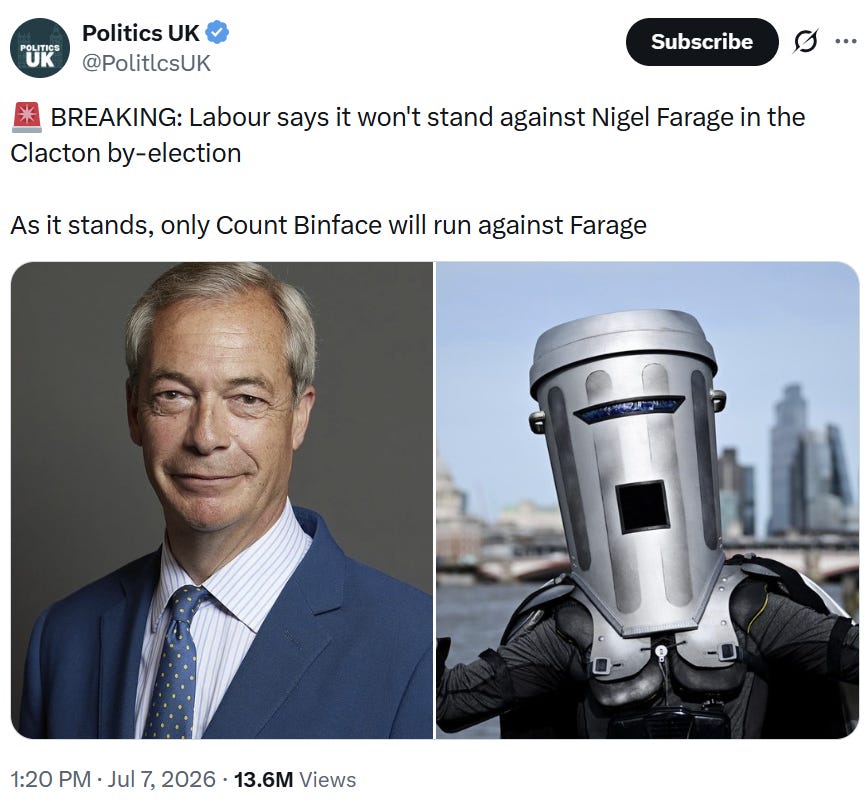
This has been your weekly report on the state of the conservative movement.
Elon Hates The Odyssey
I lied, I’ve got one more update for you on the conservative culture war. Elon Musk has been throwing a months-long hissy fit about Christopher Nolan’s upcoming adaptation of The Odyssey:
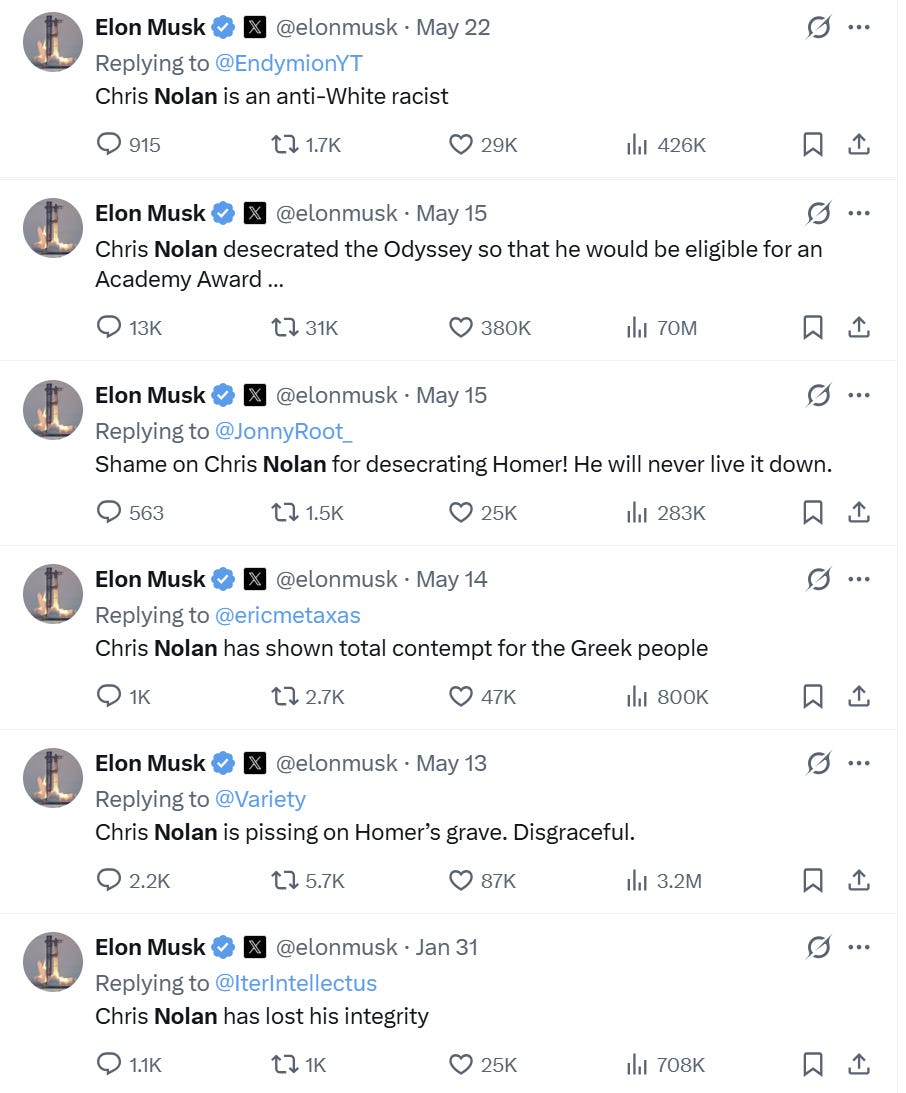
Musk, and by proxy his army of chuds on X, are incredibly angry that Nolan cast a black woman to play Helen of Troy. “It’s about ethics in video game journalism historical accuracy”, says the crowd watching a bunch of non-Greeks wearing wildly ahistorical armor in The Odyssey, a fictional story that isn’t actually history.
Critics seem to be universally praising the film in early looks, and audiences are set to make this Nolan’s largest non-Batman opening weekend. It’s damn near impossible to get a ticket to see the film on 70MM IMAX. But the heavily online right-wing isn’t having it - they’re insisting that the movie will both suck and flop, because of woke.
Elon got into a very funny spat with Tom Holland - no, not that Tom Holland acting in the movie, the other Tom Holland that’s one of the world’s most popular historians2 - about the film. Nolan invited the other Holland to watch the film early, and Holland praised the film. Elon responded by calling Holland a cuck, to which Holland replied “Very happy to say it again. The Odyssey is an amazing film, and missing out on seeing it because you think it’s woke or whatever is cutting off your nose to spite your face. Your loss.”
What strikes me about the entire ordeal is that, despite conservative culture warriors investing in this discourse for months, it’s just not working. Nobody cares, there’s no juice here. The moral panic over casting a black person isn’t actually materializing. The great anti-woke revolution where the right-wing dictated what was cool lasted all of… three months? The Odyssey is going to make a brazillion dollars at the box office, get glowing critical reviews, get a bunch of Oscar nominations, and Elon Musk’s merry band of Chuds on X simply can’t do anything about it but whine.
A Very Powerful Pasta Recipe

 Tiktok failed to load.
Enable 3rd party cookies or use another browser
Update on Australia’s social media ban
Late last year, Australia became the first country in the world to ban social media for children under 16. And it’s not going great thus far. Reuters reports:
Australia’s online platforms are stumbling at the very first step in implementing age checks for users, rendering a world-first teen social media ban ineffective, a study by a team that advised the government’s rollout of the curbs found.
A team of software testers, which last year trialed age-assurance software on more than 1,000 Australians, found that platforms did not ask for age proof on any of the 50 accounts it opened after the law came into force and on which it declared the age as 16, the researchers told Reuters.
The previously unreported finding reveals a largely overlooked flaw: while the process has so far focused on the accuracy of photo-based age-assurance software, the initial vetting stage — which guesses a person’s age range based on their general online activity — does not appear to be picking up young users for further checks.
Oddly enough, the only platform that actually required users to prove their age via uploading ID was… notably trashy streaming site Kick? Huh. Every other social media site simply believed users when they checked the box saying they were old enough. One report claimed that 70% of children still had active social media accounts.
I continue to sit between a rock and a hard place when it comes to kids and social media. I’m increasingly convinced that social media is terrible for young people, but also increasingly unimpressed with the legislation proposed to fix the problem.
Links
Netflix is still pushing to become more like YouTube.
Sony announced the end of physical PlayStation discs (and everyone hates it).
Posts
If you’re more familiar with Bill Kristol, that’s his dad.
If this kind of thing is your jam, here’s Tom Holland interviewing Tom Holland
Re: Helen of Troy...I'm not defending Elon's ridiculous crusade, but there are a couple of tendencies in that vein that honestly irritate me (or have):
-This was awhile ago now, but there was a period in the mid-late 2010s when Hollywood was habitually remaking (or sequeling) movies with black and/or female leads because, like, equity or whatever. Which is fine enough in and of itself, though it's not really my cup of tea. But these movies would inevitably generate some Vox.com article that would be like "14 reasons why a Black Captain America is the most important thing to happen for civil rights since the Voting Rights Act of 1965," which was completely insane.
-If you're aiming for realism* - which The Odyssey, based as it is on a mythical story, is not - it can really stand out when you see, like, a black guy playing an 18th century English baron. It's fine in a show like The Great, which was obviously not trying to be realistic, but if you're adapting a Jane Austen novel and playing it totally straight and the Third Duke of Essex (yes, I am making this character and title up) shows up and he looks like Idris Elba, it's...pretty weird. Masterpiece shows, which my wife watches a lot, are rife with this sort of thing.
*I'd also say it's easier for period pieces set in the distant past - I mean, do we really have a sense of what Trojans looked like? Probably not. So, eh, who cares.
Totally get that age verification is struggling, but it's a noble effort nonetheless.