

Like many of you, I spent the weekend following the breaking news in Iran, where Israeli and American forces have bombed many parts of the country and killed Supreme Leader Ayatollah Khamenei.
I’m also guessing that like many of you, my brain is a little bit broken from being on the internet for so many years. I have a tendency to think of major geopolitical events in terms of pop culture references and memes, and while it’s often an annoying habit I can’t entirely shake it for two reasons. First, because the damage from being so online can’t easily be reversed. And second, because while it sounds insane, memes often carry the perfect amount of information density. They’re metaphors to explain complex situations in terms that people can intuitively understand. References become heavily memetic because they work so well at explaining and spreading ideas.
That’s why I’ve spent the last two days wondering how it is that America has come to be ruled by Underpants Gnomes.
There’s a classic episode of the television show South Park titled ‘Gnomes’, where a group of secretive gnomes are stealing the underpants of children all around the town. When confronted, the gnomes claim to be master businessmen who have a foolproof plan to make big money:
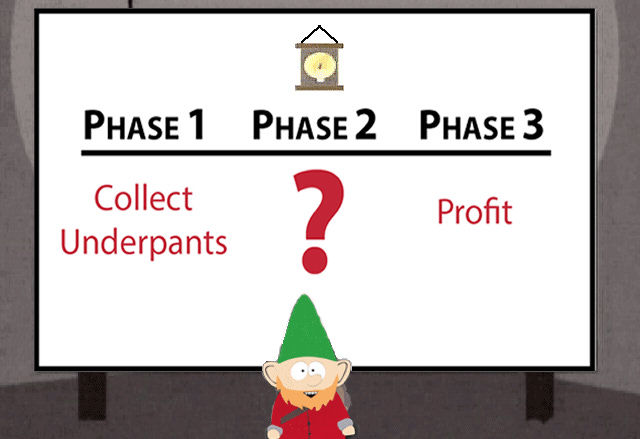
At the risk of dissecting the frog, the humor obviously comes from the missing segment in the middle. It’s the most important segment! Oh, you crazy little gnomes!
The gnomes know what action they’ve taken. They know what ultimate result they desire. They just don’t have any concrete plan to connect action with outcome. There’s no mechanism to make that happen at all.
The Trump administration’s adventures in policymaking are increasingly gnome-like:
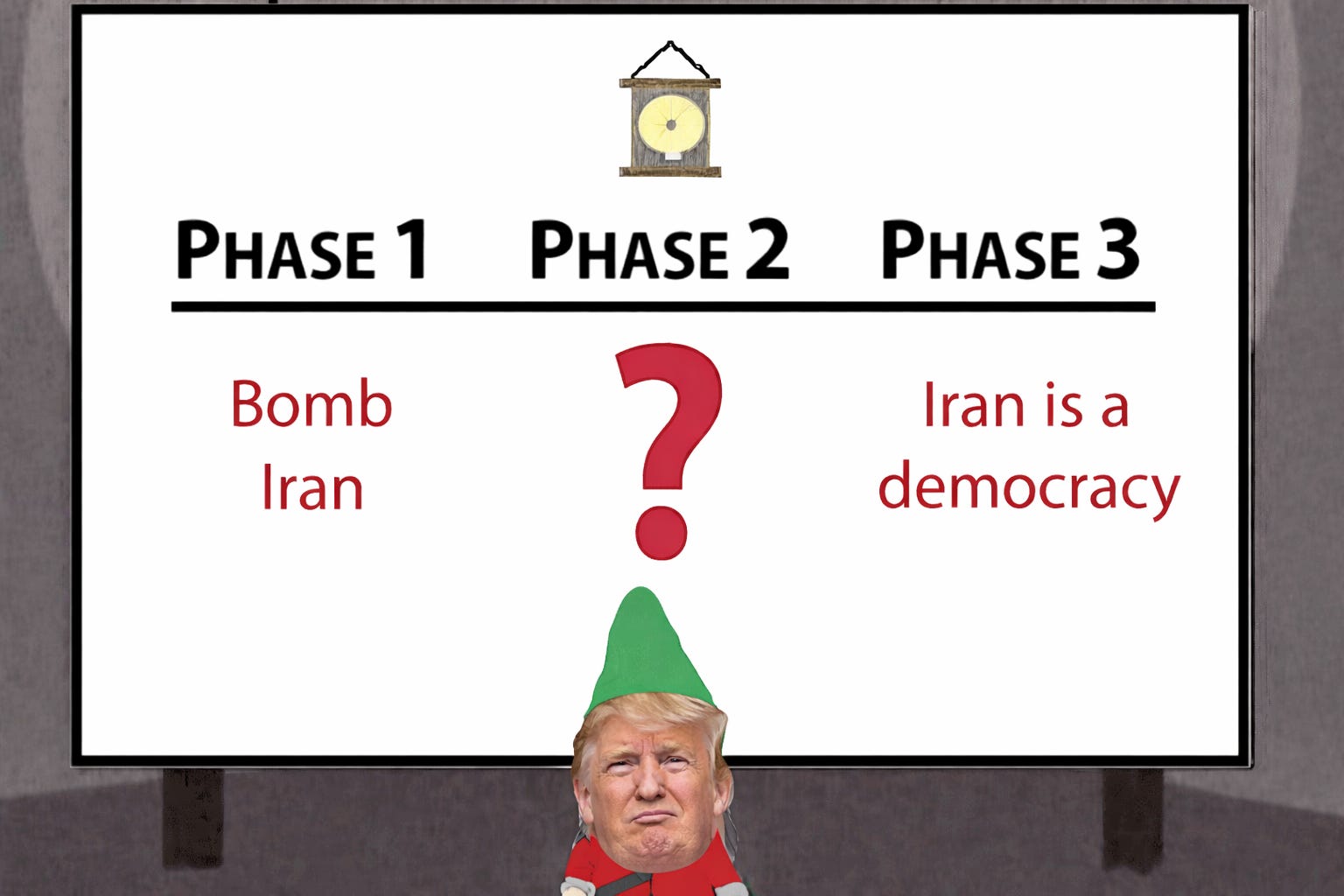
The US military was capable of taking out the Ayatollah and killing a bunch of high-level officials. So what? They’ve already elected a new interim Supreme Leader and it seems highly unlikely the government will collapse. Sure, the US and Israel are eliminating a great deal of Iran’s military capabilities via missiles and bombing runs. What’s next? There’s clearly no appetite whatsoever for boots on the ground, and you can’t force a regime change solely through air power. Iran’s opposition is fractured and unarmed, and the Iranian regime has already proven themselves willing to kill tens of thousands of peaceful protesters. Trump directly told Iranian citizens to “take over your government. It will be yours to take”. How exactly is bombing Iran going to allow them to do that? It’s Underpants Gnomes logic.1
The same logic applies to the operation that kidnapped Nicolás Maduro from Venezuela:
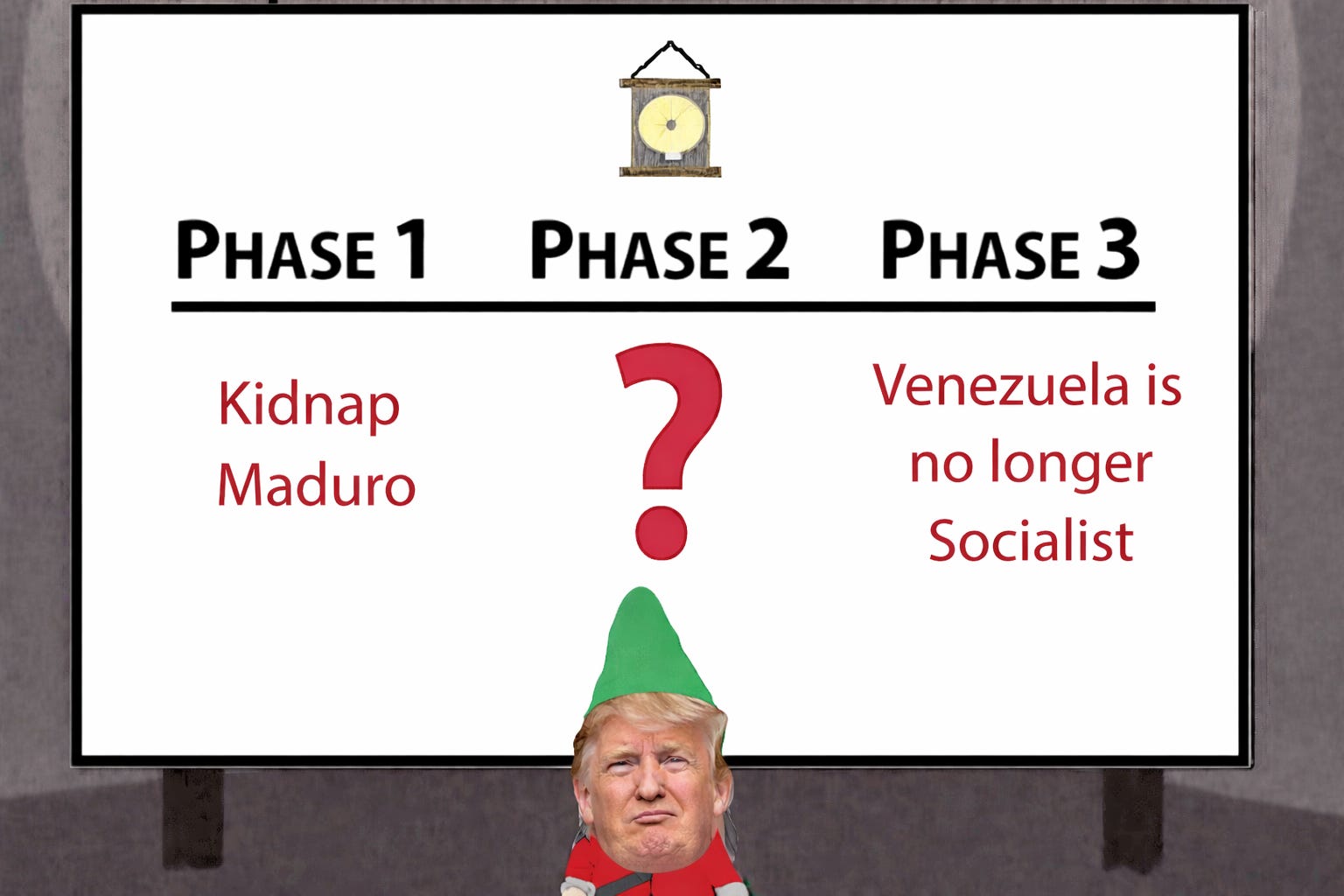
The ‘kidnap Maduro’ phase was accomplished easily. Full success! The capabilities of the American military were never really in question. Trump proclaimed that America was going to run Venezuela after the operation finished. “We’re going to run the country until such time as we can do a safe, proper and judicious transition. We don’t want to be involved with having someone else get in, and we have the same situation that we had for the last long period of years. So we are going to run the country.”
And yet months later, nothing in Venezuela has changed. Vice President Delcy Rodríguez stepped into the role of President. The socialist party PSUV still rules the country. The military, judiciary and legislature are all still dominated by regime allies. The removal of Maduro did not magically break down institutions that have retained power for decades.
The Trump administration says it’s aiming for certain outcomes. It takes decisive action. But it fails to have any idea whatsoever how to connect those decisive actions to the outcomes they supposedly want.
The same logic applies to a wide variety of the Trump administration’s signature policies. Trump has placed tariffs on nearly every country in the world, across a dizzying array of industries and products. When he’s not claiming the tariffs are for negotiating leverage, or for national security reasons, or just because someone was mean to him on a phone call, he tends to associate tariffs with the revival of American manufacturing. But how? How does putting tariffs on vanilla beans and bananas promote American manufacturing? The data shows that manufacturing has been in decline under Trump, despite the tariffs. Economists are screaming to anyone who will listen that tariffs end up harming more manufacturing jobs than they create, because they raise input prices for things like steel, lumber, and intermediate parts. But Trump doesn’t care. Step one - massive tariffs. Step two - ???? And step three, voilà - manufacturing is back. We’ll figure out the big ???? in step two at some point.
The more you look, the more you’re going to see this pattern. Want to control the border and reduce illegal immigration?
Step one - Masked agents run rampant through that notable hotspot of illegal immigration… Minneapolis.
Step two - ????
Step three - The border with Mexico is now secure.
Mad at China? See them as a geopolitical rival who needs to be contained and isolated?
Step one - Tariff, insult, and piss off every major American ally.
Step two - ????
Step three - China is now isolated and contained.
This has gone about as well as you’d expect, with Canada signing new trade deals with China in response to threats to make them the 51st state.
The common thread in these cases is a reliance on intuition, a vibes-based approach to governance. Trump understands politics in the same way he understands professional wrestling. It’s a clash of wills, a contest of bravado. Loud spectacles are better than quieter, more careful approaches. Trump builds his politics around big, showy moments without any idea how those showy moments will translate into lasting results.
His administration will identify an objective - eliminate a dictator, secure the border, make America great again - and take some bold action that symbolically aligns with that objective. But there’s almost never any real plan for the symbolic action to lead to the desired outcome.
The Underpants Gnomes believed that collecting underwear would eventually lead to profit. They just never explained how, or even realized that they had a massive hole in their logic. Trump is an Underpants Gnome, convinced of his own genius, completely oblivious to the gaping chasms in the middle of his plans.
Sometimes you’ll see people desperately trying to work out some sort of secret logic behind Trump’s actions. Surely there must be an explanation, a plan, a memo that explains it all. Surely the people running the most powerful government in the world aren’t total idiots. They have access to intelligence we don’t. They have expertise that would make the missing middle step clear, if only it were revealed. Surely Trump is just playing five-dimensional chess and we mortals are too stupid to keep up.
Over time, that charitable assumption becomes harder to believe. There are simply too many instances of grand declarations followed by actions that bear only the faintest relationship to the stated goal - with the grand declaration later quietly abandoned, thrown down the memory hole like so many Infrastructure Weeks.
Watching this all happen creates an uncanny form of political despair. It sucks here, being governed by Underpants Gnomes. You’re left with two choices, both miserable. You can choose to believe that the people making the decisions are genuinely incapable of understanding the world around them, idiots who can’t recognize the gaps in their own logic, stumbling from one clueless decision to the next. Or you can choose to believe that the stated goals are not the real goals at all. Maybe our politicians are simply liars, and that they have no shame about being liars. They don’t even bother to lie badly any more. In the words of Senator Dasi Oran, that’s the final humiliation.
What makes this especially maddening is the sense of powerlessness it produces. We’re all asked to treat each new administration policy as serious statecraft. We’re reduced to debating the merits of actions whose underlying theory of success has never been articulated. Commentators scramble to reverse-engineer the logic after the fact, like scholars trying to decipher an ancient text whose middle pages have been burned away. It sucks. And meanwhile, we all have to live with the very real consequences of all these actions - wars, economic disruption, diplomatic decay, and more.
It’s incredibly difficult for me to be calm about all this, and maybe for you as well. I feel a kind of impotent rage at the entire Trump administration, whose causal logic appears to mostly consist of a blank space labeled “?????”. We shouldn’t have to put up with this. I shouldn’t be required to write, here at the end of this essay, that in politics it’s actually pretty crucial to understand how your actions will lead to the results you want. To state the obvious, what happens in the middle step is massively important. Policies that skip those middle stages - where all the hard and thankless work takes place - are doomed to fail. That’s where you build institutions, align incentives, maintain systems, and make sure that all the tricky details are correct.
But we’re governed by a man whose model of the world involves none of that. And eventually you realize the explanation is never coming, the question marks aren’t a placeholder for some secret plan. They are the plan.
An alternate explanation for action against Iran is that it’s to stop them from acquiring a nuclear weapon. This still fails the underpants gnomes test. After the capture of Maduro and the death of Khamenei, it’s clear that a nuclear weapon is the only thing that will make America reluctant to go after you. There’s a reason that the US doesn’t try this with North Korea.
Frankly, you're giving them too much credit on having a defined Step 3 as well. I doubt Trump actually cares about whether Iran becomes democratic--he'd be perfectly happy to restore the a Western-aligned Shah and call it a day--which makes it even easier for him to stay slippery on Step 2, since the means-ends fit assumes a particular end that he is, at best, loosely attached to.
Even if you have a really detailed “step 2” model, things can and do frequently go wrong. Having some humility about this is why (traditionally) policymakers take small incremental steps, and study the results carefully, and not big leaps. But since the Trump team is utterly convinced they are the only smart people in the world with agency, here we are.