

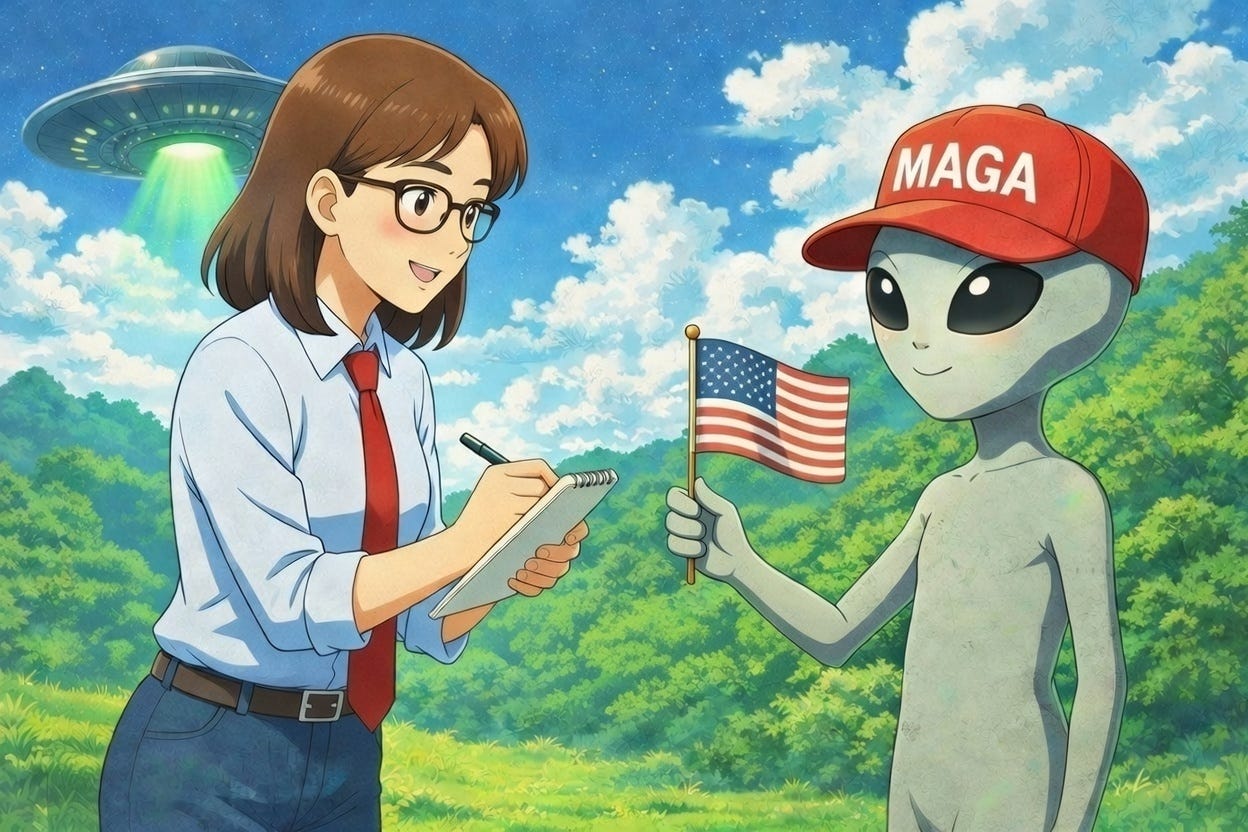
Every now and then, pundits accidentally say the quiet part out loud.
Last week, cultural commentator Kat Rosenfield criticized artists who announced they would withdraw from the newly renamed Trump-Kennedy Center, arguing that symbolic boycotts were meaningless and cheapened the artists’ work. The social media response was immediate and ferocious. Critics accused her of normalizing Trump, minimizing authoritarianism, and giving cover to Trump’s brand of self-aggrandizing politics. After significant blowback, Rosenfield clarified her position and revealed something far more interesting than her original opinion.
Rosenfield admitted that she doesn’t really criticize Trump that much in her cultural criticism, because she doesn’t see him as a normal political actor. She sees him as a force of nature, a ‘natural disaster in human form’, who is ‘boring to write about’ and functionally doesn’t have any agency:
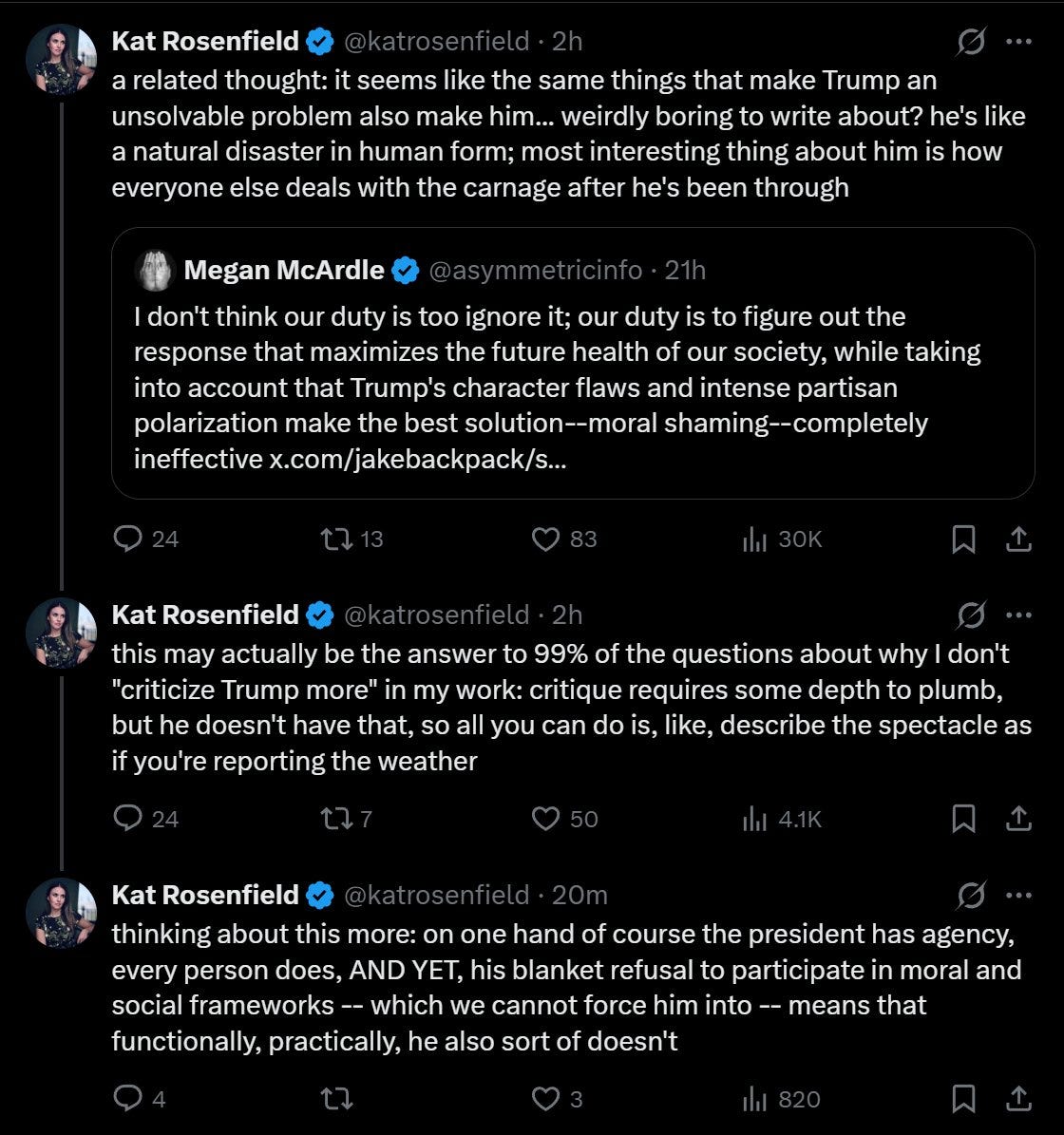
Rosenfield’s admission was met with accusations of cowardice or complicity from the howling commentariat, but she was just saying explicitly what large swaths of the media implicitly believe. Trump (and by extension MAGA Republicans) are not treated as people. They’re treated like weather systems. Earthquakes. Alien invasions. Republicans are things that happen to us, not actors we can reason with, pressure, or hold accountable in meaningful ways. Why get mad at a golden retriever for crashing your car? It’s your fault for letting it drive in the first place.
This way of viewing Republicans - and Trump in particular - is endemic in our media class. And it’s clear that this mindset explains an enormous amount about how the American media ecosystem operates every day. But why? Why do so many journalists and commentators treat Trump as though he’s an alien, beyond conventional analysis or understanding?
The media class, on a very fundamental level, does not understand Republicans. And I don’t mean “disagree with.” I mean does not understand in the most basic sociological sense.
The degree to which the media is trapped in a bubble is genuinely dire. It’s not just that media (outside of specifically conservative media) leans left, everyone knows that. It’s that media is tilted towards a very specific kind of elitism: progressive, highly-educated, urban, culturally fluent, credential-heavy, and deeply enmeshed in elite institutions. Newsrooms are dominated by people who went to the same schools, live in the same neighborhoods, socialize with the same professional class, and consume the same cultural signals. They are urbane, literate, irony-aware, and terminally online.
Almost nobody in this ecosystem meaningfully knows conservatives, MAGA voters, or Trump fans. Not as neighbors. Not as coworkers. Not as people with coherent internal worldviews. This is true even for large chunks of ostensibly “centrist” or heterodox media.
I can’t claim to see inside Kat Rosenfield’s head. Maybe she has profound, meaningful relationships with lots of MAGA voters, maybe she deeply understands their worldview. Maybe she doesn’t. Either way, focusing on a particular person misses the point. But to use Rosenfield as an example, while her politics are broadly centrist her cultural formation is similar to any other sophisticated creative-class essayist. She worked in the publishing industry, worked at MTV, worked a journalism beat doing cultural criticism of the publishing industry, and has published multiple works of literary fiction. She attended a private liberal arts college in the Northeast, lives in Connecticut, and is a podcaster. Her entire professional and social milieu is saturated with the values of the urbane elite.
Even when she departs from progressive consensus, she’s still operating inside that world. David Foster Wallace asked “What the hell is water?”, and in media circles even centrist or right-leaning pundits are swimming in the water of credentialed cosmopolitan snobbery.
This isn’t a problem with Rosenfield personally. It’s a structural issue with our entire media industry. It’s not that one person developed in a certain way, it’s that the entire media ecosystem develops that way. How many close friends does Rosenfield - or any media critic - have who believe, like about a third of Americans, that God created humans in their present form without evolution? How many people do these media critics know who sincerely believe the 2020 election was stolen with hacked voting machines (30% of Americans, 51% of Republicans)? That mass shootings are faked by gun control groups (23% of Americans)? That the U.S. government was behind 9/11 (20% of Americans, 41% of Republicans)? This is the low-trust MAGA base, and they might as well be aliens to those inside the high trust, well-educated media bubble.
Scott Alexander once described the concept of in-groups, out-groups, and far-groups. People don’t get angriest at those who are radically different from them. They get angriest at those who are almost the same. Serbians don’t spend much emotional energy hating Malays or Inuit; those groups are too distant to register at all. They reserve their fury for Croatians or Kosovars, groups who are highly similar but different in one or two key ways, a narcissism of small differences.
Media fights work the same way. Highly educated socialists fight highly educated centrists. Progressive journalists feud endlessly with slightly less progressive journalists. These are high-emotion conflicts precisely because everyone involved shares a common cultural language.
MAGA Republicans, by contrast, are a far-group. They’re culturally alien, so distant as to feel more like abstractions than people. This is why, through the rise of Trump’s movement, so many thinkpieces have been written that are essentially political exoticism - look at the Trump voters! See what they think! Wonder at their strange and uncanny ways! Rather than treat Trump voters (or Trump himself) as normal actors with different views, they’re a bizarre subculture to be decoded. And because they’re so distant and alien, you can’t reason with them. You don’t argue with a hurricane. You don’t negotiate with gravity. You simply lament the damage and move on.
Most journalists let the idea that Republicans are aliens govern their behavior quietly. Rosenfield was at least willing to say it explicitly, and deserves points for honesty. But the problem with this stance is that the stance is bullshit.
Republicans are not aliens. MAGA voters are not NPCs. Trump is not a force of nature. All of these people are conscious, feeling actors who respond to incentives, pressure, social status, and persuasion just like anyone else. Trump himself is famously suggestible. He watches television obsessively. He is influenced by pundits he trusts. Pressure groups are known for buying ads during specific Fox News shows because they know he will see them and adjust his behavior accordingly.
Conservative media personalities understand this perfectly. They don’t treat Trump as an alien. They treat him as a human being with agency, one who can be flattered, threatened, nudged, or embarrassed into changing course. And crucially, they believe he can be credited or blamed for what he does.
Large portions of the mainstream media, by contrast, have absolved themselves of this responsibility. If Trump is a force of nature, then nothing is anyone’s fault. Nothing can be altered, and nobody’s to blame - except liberals who react to the hurricane, or who get mad at the hurricane for what it did. It’s ridiculous on multiple levels when cultural commentators proclaim that Trump is boring and uninteresting. Trump might be the single most fascinating fixture in modern political history! If you find nothing interesting about trying to understand what makes Trump tick and how he can so consistently operate outside traditional norms, you should probably find a job outside cultural commentary.
And more than just being a bizarre, wrong view of the world, the ‘Trump is an alien’ viewpoint is dangerous. Nobody really cares that much how many jazz musicians cancel at the Kennedy Center, or whether or not Hamilton goes on with their planned performances. But a fun fact about the President of the United States is that he has vast powers and can completely upend the civilized world if he so chooses. This morning the United States kidnapped the president of Venezuela in an operation that is likely illegal and certainly destabilizing to international order. What’s our response to this supposed to be? “Oh well, that rascal Trump! You can’t really control him, he’s just a force of nature, gotta ride it out, no use complaining?” To hell with that.
This pattern doesn’t capture everyone. There are still journalists who insist on treating Republicans as people, who apply sustained pressure, demand accountability, and refuse to surrender agency. But the broader trend is deeply entrenched. Between professional pressures, audience capture, and the attention economy rewards for intra-tribal combat, the incentives to ignore Trump and engage in intra-factional bickering are incredibly strong. I’m not the first person to notice this and I won’t be the last.
Still, it’s worth calling out whenever it appears.
Journalists who treat MAGA as an alien force are not merely being lazy or snobbish. They are actively harming the country by abandoning the idea that politics involves human beings who can be influenced and held responsible. This posture should be rejected.
Speaking as a member of the urbane media class: we need to get over ourselves. We need to insist, publicly and relentlessly, that Republicans are people, not aliens. That Trump is a human being, not a thunderstorm. And that agency matters - because without it, accountability disappears, and democracy rots from the inside out.
So this is all a bit surreal, but I do actually agree with one point in all of the above, which is that this essay is NOT about me personally! This "Kat Rosenfield" person — urbane, highly educated, comfortably entrenched in the Ivy League-to-elite media pipeline, probably does cocaine in the bathroom at parties— is a figment of the author's imagination, albeit one so much cooler than me that I’m almost tempted to let people think she exists.
But, in the interest of the truth (which we presumably all care about), I think I should probably correct the record. So: hi, I'm Kat. I'm 43 years old and was raised in a town of 3,000 people in deep red, rural upstate NY, where my dad was a physician at the local prison. My graduating class (public school) was 90 people and I went to a no-name college that gave me a scholarship, then applied for a Publishing Job in the Big City because I liked to read (yes, I was a massive rube, feel free to make fun of me). Unfortunately, this latter chapter of my life ended in 2008 when the economy crashed and was an absolutely extraordinary failure on all counts, except that I have been married for nearly two decades to a really handsome man who I met through my first job.
And yes, I've managed to build a career as a full time freelance writer since then, through a combination of hustle and sheer dumb luck— but that's because I've spent the past 17 years hammering on a keyboard in my living room in a random town in Connecticut where we moved for my husband's work, far from the giant high school cafeteria known as the Urbane Media Sphere. The elite club of "people who went to the same schools, live in the same neighborhoods, socialize with the same professional class, and consume the same cultural signals" described here is one in which I have never belonged, nor wanted to. I don't come from that world! It's not a milieu I'm comfortable in — and judging by the way its members (including the author of this piece) talk about me in public, I get the distinct sense that I wouldn't be welcome there even if I wanted to.
All of which is to say, flattered as I am to be mistaken for a member of this clique by one of its reigning Queen Bees, it is a mistake — as is his using me or my work to represent the modal clueless elitist who thinks Republicans are aliens. Half my family are Republicans! As are a number of my friends, although I couldn't necessarily tell you how any of them voted in the last election because, and I can't stress this enough, normal people don't care that much about this shit. We don't talk about politics when we get together; we talk about football, or people's kids, or where Michelle got her deviled egg recipe.
As for the post to which this piece is a purported response, as I personally explained to Jeremiah on X/Twitter yesterday, there is an obvious, substantive difference between "Trump's uniquely amoral behavior makes him a paradoxically flat character in the soap opera of American political culture," and "Trump is boring and uninteresting," which is not just an arguably illiterate interpretation of my post, but one belied by the fact that I've written hundreds of thousands of words about Trump and his place in the culture since 2016 (I'll leave a link to one of my favorites below if anyone's interested in reading it.) The fact that Jeremiah chose to ignore my clarification and write an entire article about how me and my work are a microcosm of "credentialed cosmopolitan snobbery" is, I have to say, a pretty incredible example of the phenomenon under discussion.
Anyway, to those who got to the end of this novel of a comment, thanks for reading! And if you want to read a little more, here you go:
https://www.thefp.com/p/2024-election-is-marvel-universe
this tracks with what Hannah Arendt wrote in Personal Responsibility under Dictatorship. You have to maintain that people have agency, and can choose alternatives, in order to be able to logically judge them for their choices. Another idea by Arendt was that Totalitarian governments need for people to view their acts as inescapable Fait Accompli, a.k.a. forces of nature. We most resist this and respectfully engage Trump supporters as humans with agency if we have any hope of turning our society away from Totalitarianism.