

This article was originally published over at The Dispatch.
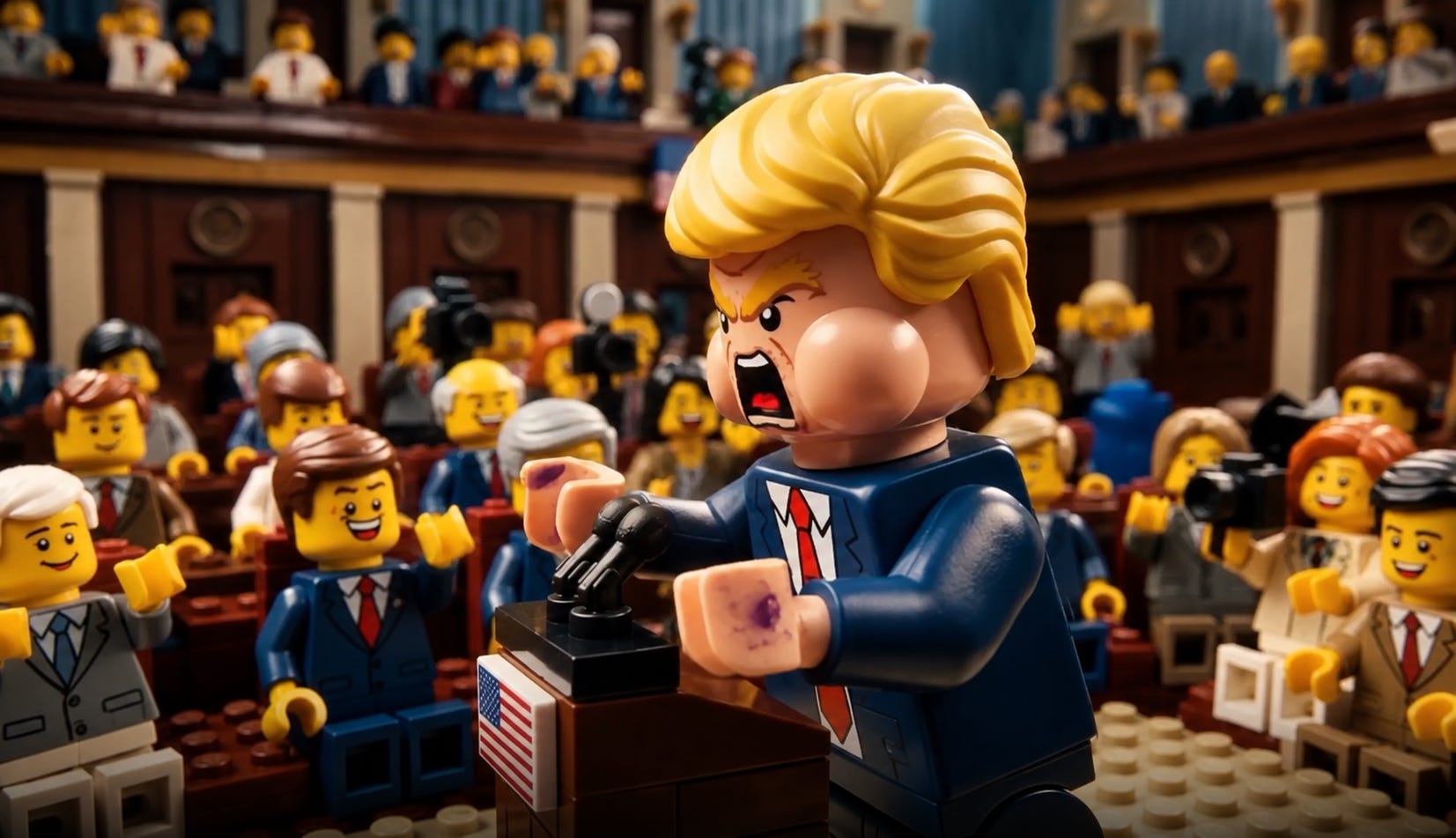
If you’ve been following the war in Iran on social media, you’ve probably seen the Lego videos.
One AI-generated clip features a Lego version of President Donald Trump eating pizza from a box labeled “Epstein Island,” depicts him as a clown and a pig, and shows Israeli Prime Minister Benjamin Netanyahu walking him on a leash, among other things. “Whole world watchin’ a tantrum, talk big from a gold-topped mansion,” a voiceover raps in another, showing Lego Trump shouting into a golden megaphone. “Snowflake ego so fragile, can’t handle the smoke, MAGA waking up, country going broke,” sings yet another while insinuating the recent shooting at the White House Correspondents’ Dinner was staged to distract from Trump’s wartime failures.
Other videos portray Trump crooning as an ’80s pop star, begging Iran to let ships through the Strait of Hormuz or show Lego Shahed drones taking out cargo ships in the waterway. And the memes aren’t limited to AI-generated Lego figures or songs. Iranian diplomatic missions are engaging in their own brand of “wolf warrior” posting, with the Iranian embassies in Tajikistan and India showing Jesus punching Trump and Trump bowing down in front of an Iranian warrior. The Iranian Embassy in Zimbabwe responded to one of Trump’s ultimatums to make a deal with “8 P.M. is not that good. Could you change it to between 1 and 2 P.M., or if possible, 1 and 2 A.M.? Thank you for your attention to this important matter. I.E.Z”
Iranian accounts, both official state-run accounts and affiliated groups, have spent much of the war shitposting about the president’s ineffectiveness, insulting him, calling the war a distraction from domestic troubles like the high cost of living and the Epstein files, and in general refusing to take Trump’s threats seriously. The Iranian Embassy in South Africa joked that “regime change” had already happened by posting an image of high-ranking U.S. defense officials recently fired by Secretary of Defense Pete Hegseth.
Propaganda flows both ways, but it’s remarkable how little ability the Trump administration has had to counter these wildly viral Iranian posts, which can rack up millions of views each. Trump’s frequent rants on social media are the subject of mockery, prime material for late-night hosts and fodder for those who say the president is suffering a decline in his mental faculties. Former Trump administration officials are ignoring official messaging in favor of glumly posting about how the Iranian regime is going to survive and the U.S. will likely have to tuck tail and leave.
And Trump’s own wartime messaging campaign has done little to inspire confidence.
On the fields of Gettysburg in 1863, Abraham Lincoln declared that “this nation, under God, shall have a new birth of freedom.” Following the Pearl Harbor attack of 1941, Franklin D. Roosevelt vowed that “the American people in their righteous might will win through to absolute victory.” Ronald Reagan demanded in 1987 that Soviet leader Mikhail Gorbachev “tear down this wall.” Trump, by contrast, posts things like:
“Open the Fuckin’ Strait, you crazy bastards, or you’ll be living in Hell - JUST WATCH! Praise be to Allah.”
This is pure bluster, and observers on both sides know it. There’s a meme war that’s happening concurrently with the real war, a meme war that Iran is winning. And that has real implications for the future of U.S. foreign policy.
Propaganda has always been a part of American military conflict. William Randolph Hearst’s yellow journalism following the explosion of the USS Maine in Cuba helped push the United States into war with Spain in 1898. The late Sen. Hiram Johnson of California once noted that the first casualty of war is truth, and while that saying has become a timeworn cliche, like so many cliches, it remains relevant because of how often it’s shown to be true.
The propagandists of World War I are famous for depicting Germans as apes and brutes, but it was during World War II that the United States began making a concerted effort to spread propaganda abroad, not just at home. Radio broadcasts targeting foreign populations became more common, and dropping leaflets over enemy territory was so popular in the Second World War that the U.S. devoted an entire squadron of B-17 bombers to the task. Other countries adopted similar tactics—during the Vietnam War, Hanoi Hannah broadcast several radio segments a day designed to demoralize American troops. Radio Free Europe was a mainstay of the Cold War, as was the Soviet funding of communist literature in the West.
Wartime propaganda has always existed, but in the last five years or so the nature of the messaging has radically changed. Consider the 2022 Russian invasion of Ukraine and subsequent rise of the North Atlantic Fella Organization, or NAFO, movement. The meme began in May 2022, with an artist who posted pro-Ukraine content using the popular Shiba Inu dog (of Doge fame). The posts quickly evolved into a community of pro-Ukraine social media users, with NAFO posters celebrating Ukrainian victories, raising money for equipment, and sparring with pro-Russian voices online. They were successful enough that Russian diplomats often just stopped posting entirely when targeted by NAFO accounts.
This all seems silly—cartoon dog avatars yelling at old Russian men and posting memes about Javelin missiles—but NAFO, alongside official Ukrainian efforts, had a real impact on the public’s perception of the war. Ukraine won the online messaging battle decisively, and that win has likely enabled the country to secure billions in valuable military aid from international supporters. Those cartoon dogs may have made a real, material difference in Ukraine’s ability to defend itself.
As this trend shaped the Ukraine war, it also began happening nearly everywhere else. India and Pakistan engaged in a low-level conflict in May 2025, and as expected partisans on both sides spent an enormous amount of time bickering with one another. But what was new was posts by the Indian army’s official X account featuring slick graphics and video edits, and sensationalized tweets from the Pakistani minister of defense, including a clip from a shootout from The Good, the Bad, and the Ugly in which one character labeled Pakistan kills another labeled India. When Hamas invaded Israel on October 7, it started more than just a traditional conflict. It started an online propaganda battle between pro-Israeli and pro-Palestinian camps that is still raging to this day.
In a 2023 piece here at Infinite Scroll, I wrote about the changing nature of propaganda and identified three ways in which modern meme wars differ from traditional propaganda: immediacy, directness, and decentralization.
Immediacy. Meme wars take place at the speed of social media. What might have been an effective message last week has no guarantee of resonating this week. And social media messengers don’t have time to centrally plan a set of messages and themes; they need to post now. Real-time information is flowing about which buildings have been bombed, where troops are being transported, and what one’s adversary is claiming, so modern meme warfare requires users to be incredibly fast on the draw. Opinions are shaped online within minutes of any particular incident, and slow responders risk being left behind.
Directness. Older forms of propaganda were for the most part unidirectional. Dropping leaflets over a wartime enemy doesn’t constitute a dialogue. Radio Free Europe promoted pro-American viewpoints during the Cold War, but it was a one-way broadcast. Back then, your enemy might have internal propaganda radio programs that rebut some of your channel’s central claims, but the dueling points of view were not engaging in a live debate. They were separated by time and space.
Social media works differently. If users post wartime content, they need to be prepared for adversarial accounts to respond within minutes in the replies, or with customized rebuttals in their own posts. Propagandists are now fighting with each other directly, in real time, dueling it out in Discord channels, subreddits, and comment sections. What used to be a stately one-way messaging machine is now an omnidirectional free-for-all that is taking place all the time, everywhere, which leads to the last key difference:
Decentralization. In the past, propaganda was largely funded and directed by the state. Governments would craft a message, debate it, test it, and expend significant resources to spread it to the correct audience at the correct time.
Today, propaganda starts online, and governments have less control than ever over what gets said. It’s almost always the case that the first attempts to spin any new development come from anonymous, amateur commentary accounts that aren’t being paid to post by any government. They may be partisans of one side of a conflict, but like NAFO, they’re decentralized and fundamentally outside the government’s control. Many of the most prominent users posting about conflicts like the war in Iran or between Israel and Gaza have no real connection to the governments in question.
Propaganda today isn’t carefully crafted by mastermind government operatives. It’s chaotically created by armies of independent accounts all rushing to coin the next big slogan or viral meme. Governments around the world are along for the ride—they can try to direct their partisans’ energy, but they certainly can’t control what gets said in any real way.
But that’s not to say they haven’t tried. The second Trump administration in particular has leaned heavily into memes. Official accounts have shared mocked-up images of an immigration enforcement “Speedway Slammer,” posted ASMR deportation videos, and digitally altered images of detained protesters to make them appear as if they were crying. The administration named a new government initiative after the same meme dog that members of the NAFO community use in their avatars. MAGA is very online and highly meme-literate, which makes its failure in the current meme war against Iran all the more surprising.
The Islamic Republic is taking advantage of the nature of modern propaganda. Its Lego videos are produced and posted by independent contractors and have become so popular that even accounts without any affiliation with the regime have begun to copy their style. The posts are memeified—ironic and facially unserious, but with pointed commentary lurking underneath the surface. And because the public is so skeptical of Trump’s stated reasons for going to war, these messages are landing. The public is genuinely more receptive to an Iranian video in which a Lego rapper claims that the war is a distraction from Trump’s ties to Jeffrey Epstein than they are to yet another Truth Social rant.
The U.S. military is clearly superior to that of Iran, but that hasn’t guaranteed success in the current conflict—in part because the American public’s appetite for war is so low. In an interview with Foreign Policy, Iranian propaganda expert Phillip Smyth noted how successful Iran’s digital campaign has been:
Something I found fascinating: We’re the only ones talking about those Lego videos. They’re not talking about them in Iraq, they’re not talking about them in Bahrain, they’re not talking about them in Lebanon. … We’re the ones talking about it, which means they’ve been successful.
For most of our history, Americans have assumed that we were the good guys. We have defended democracy, fought fascism, defeated communism, and championed the cause of freedom and prosperity worldwide. To the extent that propaganda was deployed in the process, Americans were confident it was for worthy ends.
Today, that confidence has eroded. Largely due to the rise of social media, Americans today are more skeptical of elites than ever before, and increasingly skeptical of their own country’s motives and moral claims. Large shares of the American public no longer believe the story their government tells the world, and it is in this context that Iran’s meme blitz has been so successful.
Two decades ago, it would have been difficult to imagine embassies posting like comedians, governments paying for animated Lego raps, and global conflicts unfolding in comment sections and chat rooms. But the distance between statecraft and shitposting is smaller than it’s ever been, and America is currently being left behind in the meme wars by nimbler and more creative combatants.
Not gonna lie, the NAFO memes are the main reason why I’m loading up on St. Javelin patches for my airsoft harness.
Great article!!
And one thing I think about is, “being Online” != “being savvy in online propaganda” and I think this is especially true for MAGA.
For one thing, I think what Noah Smith is describing is happening on this front where as Donald Trump gets more unpopular, the ppl who are left are even more committed and insane (like that Florida pastor who praised Trump’s gold statue) - and this is like a recipe for creating memes that only appeals to very narrow set of ppl.
And ngl there seems to be a bit of low quality audience problem where they approve low quality memes…
While I’m not a huge fan of him, I think ettingermentum made an apt observation “current MAGA meme scene is millennial uncs wink wink and try to look cool to Genz (and in reality uncs just wink to each other)”