

Earlier this week I wrote about how the 2024 presidential campaign played out online. Trump’s team bet hard on the internet while the Harris campaign bet on traditional campaign strategies, and it turns out that the Internet is More Real than Real Life.
It’s important to talk about how and why this happened. I’m a liberal and don’t bother to keep that a secret, but I try to keep things pretty balanced here and I have plenty of criticism for Democrats. What I want to do is analyze the facts of the case in a dispassionate way. Descriptive rather than prescriptive. You can’t understand what happened on Tuesday unless you understand the how culture has changed.
Kamala Harris lost this week. By some measures, it was a crushing defeat - the first time since 2004 Democrats have lost the popular vote to Republicans. But by international standards, Democrats did quite well. The chart below shows the performance of incumbent parties by year, worldwide:
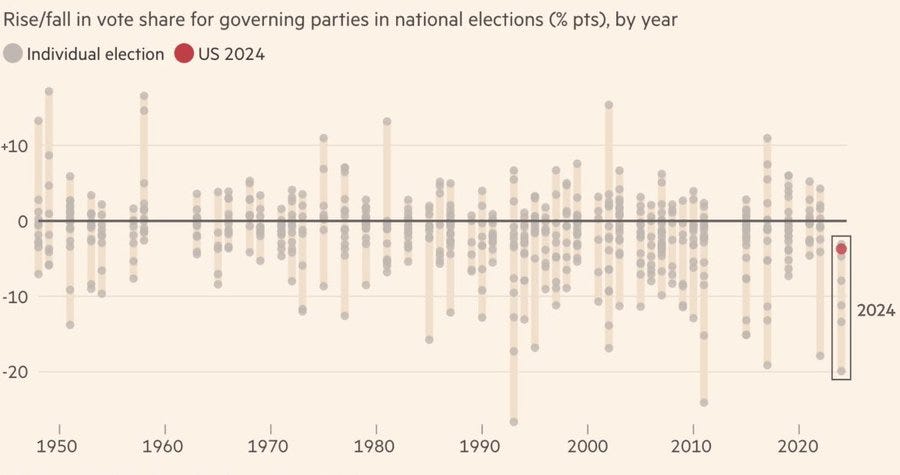
2024 is the first year on record where every single incumbent party has lost vote share, no matter the country. It’s simply a bad time to be in power, no matter your ideology. But that red dot at the top of 2024 is the Democrats. They did better than nearly any other party internationally.
What that tells me is that there’s limited blame that can be put at the feet of the Harris campaign itself. When everyone is losing, you have to look for large structural changes and not individual campaign decisions. For the most part I think Harris was put in a tough position and performed reasonably well. One could make the argument that Democrats aren’t really to blame here and don’t need to learn any lessons - it was just bad luck and bad timing.
But that argument would be too easy. Democrats performed better in many key Senate races and Congressional races than they did in the presidential race. Despite losing these states to Trump, Dems won the governorship in North Carolina and Senate races in Michigan, Wisconsin, Nevada and Arizona. Candidates like Colin Allred, Sherrod Brown and Jon Tester outperformed Harris’s vote totals despite losing. The point being - there are things Democrats can do to improve their performances. And it starts with understanding how the national party has changed over the last decade or so.
A Party of Scolds
When I was growing up, my vague perception of politics was that Democrats were the cool party and Republicans were the party of lame, upright scolds.
Which party was more likely to get mad at you? Definitely conservative Republicans. This was the age where the Moral Majority was still influential and conservative Christianity was at the forefront of Republican thought. If a song was too obscene, if a woman dressed a certain way, if anyone dared be gay in public - Republicans got mad. They were the party of scolds, the party of lectures and book banning and righteous indignation at stuff that a lot of us would just shrug at.
Somewhere along the way, that changed. Who today is more likely to lecture you for saying something they consider offensive or out of bounds? It’s obviously Democrats - specifically progressive Democrats. Today it’s progressives, not conservatives, who are prone to scolding and nagging. It’s progressives who try to cancel people for using the wrong pronouns or having the wrong opinions or saying the wrong thing about race. Conservatives are now the ideological movement that embraces edgy contrarianism. You may think this is good or you may think it’s bad, but I don’t think it can be denied that this is the state of things.
This happened long before the Harris campaign started. Kamala actually put some effort into not doing this kind of stuff - for instance, she rarely leaned into her race and rarely talked about trans issues. But she couldn’t escape the overall perception that Democrats have become stuck with.
One of the major problems for the Democratic Party is that there’s a whole host of people who speak for the party but aren’t formally tied to it. There is a giant blob of progressive activists, non-profit workers, celebrities, academics, journalists and online personalities who color people’s perceptions of what Democrats believe. These are the folks who’ve gone all in on identity politics, DEI, and that kind of wokescold lecturing. Elected officials and their formal teams usually aren’t as bad, because they’re disciplined by electoral politics. They lose if they go too far. The giant blob isn’t disciplined in that way. Their incentives run in the opposite direction - purity is rewarded within the group and the loudest and most extreme voices usually get the most attention.1
What results is a system where the left ends up purging its dissidents while the right welcomes them.
Shun the Non-Believers
The best description of how the left has been systematically expelling those who deviate from progressive politics comes from Matt Yglesias, talking about the Democratic ‘pitiless machine’:
But the other pitiless machine was relentlessly focused on shrinking the ideological tent, making it clear that troublemakers were at risk of being purged. This coalition-narrowing machine had a good amount of success vis-à-vis tech and Wall Street and very limited success in kicking “Zionists” out of the progressive tent. But it was at work across a broad suite of issues, and most elected Democrats responded to the tension between these two machines by ducking conflict wherever possible.
The net result of all this lecturing and nagging is that progressives push people away. The best way I’ve seen this phrased is that if you disagree with a progressive on one thing, they’ll kick out you, but if you agree with an alt-right guy on one single thing he’ll gladly welcome you into the tent.
Here’s Yglesias again:
That said, I do hear what you’re saying. And I think the answer is basically that these shows have trended towards the right because the left is so much more ideologically rigorous.
Just as a toy model, imagine a person who spouts off political opinions at random but vaguely in line with their popularity in the public. So if he’s asked about the minimum wage or marijuana legalization, he probably says it’s good. But if he’s asked about nonbinary pronouns or banning gas stoves, he probably says it’s bad. This guy is realistically much more likely to get yelled at by people on the left. Notably, even if he says, “No no no, among my list of random opinions is that I think Trump is bad and I voted for Obama twice,” it’s still leftists who are more likely to get angry and yell.
That paragraph is a near perfect description of Joe Rogan. Rogan is not a guy with sophisticated political views. He’s a confusing mishmash of beliefs that nets out somewhere vaguely centrist. And for that, progressives hate him. They lecture others about how listening to him is problematic and he’s a ‘podcast bro’. But conservatives embrace him. It doesn’t matter to Trump that Rogan wants to legalize all kinds of drugs or that he might favor expanded healthcare, Trump welcomes him into the tent and actively courts his endorsement.
It turns out that “incessantly lecture people about how problematic they are and scold them for any deviation from the party line” is not a great strategy for attracting voters! But it’s an especially bad strategy for one group in particular that played a huge role in this election.
The Podcast Election

I mentioned Rogan above purposefully. One of the main points I made earlier this week was that podcasts played a huge role in this election, and Trump courted them far more than Kamala did. Whether it was the Nelk Boys, Logan Paul, or Rogan himself, Trump was very active and very popular on the podcast circuit.
Podcasting, as a medium, was pioneered by comedians and is still dominated by comedians and comedian-adjacent personalities. If there’s one group in American society that really, really, really, really hates being scolded about what they can and can’t say, it’s comedians. They’re highly sensitive to formal First Amendment issues but also to informal cultural lecturing and cancellation campaigns. Much of comedy is saying the unsayable in clever ways, and progressives are now the enforcers of what’s unsayable. It’s not an accident that podcast comedians have shifted dramatically to the right over the last decade.
Democratic hand-wringing about the election has caused a fairly interesting discourse to pop up around Rogan in particular - with many saying Democrats need to create their own Rogan:

There are a number of problems with this approach.
The first problem is that you can’t just ‘build a Joe Rogan’. Rogan has an audience of more than a hundred million because he is an incredibly talented entertainer who spent decades building his personal brand and voice. That’s not something that can be recreated with a few months of hard work and some funding.
The second reason is that if you wanted a version of Joe Rogan open to Democratic candidates, he already exists and his name is Joe Rogan. Rogan has said he thinks Obama is the best president of his lifetime. He’s spoken favorably about universal healthcare and drug legalization. He’s had on many progressives and Democrats. He interviewed Bernie Sanders and Andrew Yang and liked both. Joe Rogan is a perfectly winnable vote, but you have to make a real effort to court his vote. The problem is that when Sanders went on Rogan, his own supporters were furious. The Democratic activist class decided they didn’t need Rogan and didn’t want him because he has strange and heterodox views. Purity was more important than expanding the tent.
This leads into the third reason you can’t build a Democratic Joe Rogan - even if you did, the progressive wing of the party would tear him down. We know this is true because it just happened.
Dropout is a popular, independent comedy streaming service that hosts shows with dozens of comedians. It’s been highly successful, is profitable, and has hundreds of thousands of paying subscribers and an even larger audience through social media. They do internet-flavored alt-comedy sketches and have a highly progressive slant they proudly wear on their sleeve.
A few weeks ago, they invited comedian Noah Grossman on one of their shows Dirty Laundry. This was pretty standard for them - they often invite a wide variety of comedians to guest in their sketches. But one of their fans dragged up something that Grossman had said six years ago where he spoke positively about how his great-grandfather was involved in the founding of Israel. This turned into an accusation that Dropout was ‘platforming Zionists’ and absolutely tore the Dropout fanbase apart.
People posted long rants about how problematic Dropout was acting. There was sarcastic shaming. Reddit comment sections tore themselves apart fighting about it. Dropout fans organized boycotts on TikTok.
To be clear, Dropout is wildly progressive. They’ve raised money for Palestinian charities. The company’s CEO is literally the son of left activist Robert Reich and if the company’s talent leaned any further left they’d fall into the Pacific Ocean. And yet their fans attacked them anyways! Not even for their own sins, but for platforming a guy who may have said a vaguely positive thing about Israel six years ago. Given a popular, growing media service on their side, the left immediately sabotaged it.
Joe Rogan is an important political voice for two reasons besides just audience size. First, he’s nominally non-political. His shows are mostly about other stuff and he only sometimes jumps into politics. Second, he has a vaguely centrist and everyman-ish approach to culture and policy. As mentioned above, his worldview is a confusing mishmash of ideas that don’t always fit together ideologically. A progressive version Joe Rogan could only exist if they kept exactly to the party line at all times, but by doing so they wouldn’t be Joe Rogan.
Right wing vs Left wing Media
This points to a fourth and related reason why there isn’t a Democratic Joe Rogan, a reason that has to do with media ecosystems. We all know about the mainstream media. There’s also a very powerful and separate conservative media ecosystem that’s been grown through conservative activist channels for decades, which encompasses talk radio, cable news, online platforms and now podcasts. There does exist a progressive/left media ecosystem, but it’s much smaller than its conservative counterpart.
The problem for Democrats is this: The conservative media ecosystem spends almost all of its time furiously tearing down the Democratic Party, while the progressive/left media ecosystem also spends its time tearing down the Democratic Party.
This is what leftist commentators like Taylor Lorenz fail to account for in their analysis of why a left Joe Rogan is impossible. Lorenz correctly identifies that a left Joe Rogan isn’t going to happen any time soon, but mostly seems to blame the problem on how much funding billionaires give to conservative media.2 But that’s what she would say as part of the progressive blob that sticks the Democrats with unpopular views and spends all her time complaining about Democrats. And she misses that while conservative funding goes to building a conservative ecosystem that tears down Democrats, progressive funding also functionally tears down Democrats. Right commentators give near-universal praise to their team, while left commentators like Lorenz and Hasan Piker spend their time criticizing Democrats and purity testing them over toxically unpopular views.
This progressive urge to always be criticizing your own party has real implications for candidates. Harris did a reasonably good job of not focusing on divisive culture war issues, not leaning into identity politics stuff, and generally avoiding the dumbest progressive stances. But she did that mostly by staying silent about those stances, rather than affirmatively attacking them. She doesn’t come out and say “Prison abolition is stupid and we’re never doing that, you moron.” She doesn’t say that Robin DiAngelo is a shameless grifter or that the word ‘Latinx’ is fucking stupid. On any number of issues, rather than vocally breaking from the unpopular progressive position, she kept silent.
That’s the ultimate reason why the online media ecosystem has turned so sharply against Democrats and the left more broadly.
The progressive movement has become a movement of scolds.
They criticize and are eager to purge any voices from the ranks who break from progressive orthodoxy.
This alienates moderates, independents, people who are generally non-political and people with a mix of viewpoints.
This process is especially potent online and hits the comedian/podcast world especially hard.
The progressive media ecosystem that does exist is either cannibalized by its own fans or dedicated to criticizing Democrats.
This makes Democratic politicians afraid to say much of anything against progressive activists - unless it’s an acute PR crisis like ‘Defund the Police’, they stay silent.
Democrats can’t simply build a version of Joe Rogan that agrees with them on every point and never makes progressives mad. That’s impossible. If they want to win over Joe Rogan types, they need to actually change their method of politics. They need to marginalize the camp that spends its time scolding people and shrinking the tent. They need to focus on welcoming people into the tent, even when those people are off-putting or disagree with them on some stuff. They need to vocally attack stupid ideas, even if it makes activists angry. And until they do those things, we’re going to see the Podcast Bro online environment continue to trend right.
This problem is especially pernicious because liberals have developed a stranglehold on so many elite pathways - higher education, Hollywood and the civil service are dominated by left-of-center voices.
Lorenz does get *so close* when she notes that Bernie went on Rogan but then Bernie’s fans got mad afterwards. That’s the point! That’s the main thing!
As a sidenote: I'm hoping at least a few of you get the 'shun the nonbeliever' reference or I'm going to feel very old
I would like more evidence on the causal relationship between internet culture and the election result, especially compared to more factual stuff like inflation and immigration.